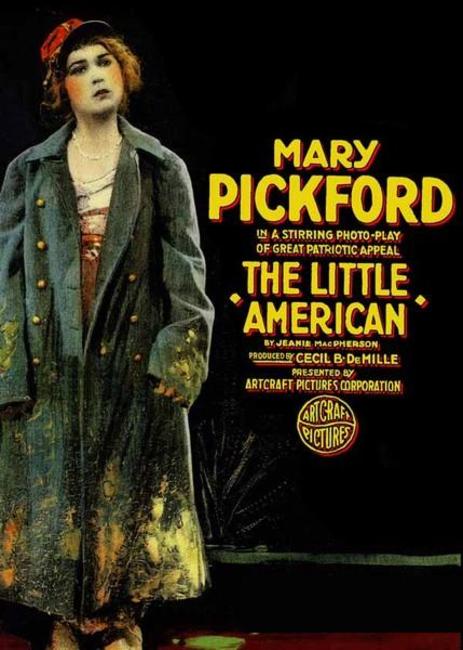
Little American (1917)


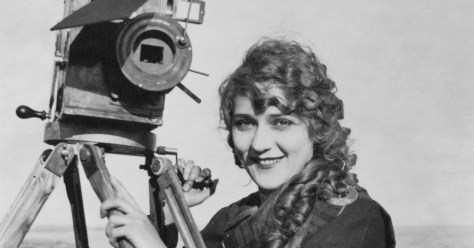
Mary Pickford 1

Mary Pickford Season: FD Cinematheque

Little American (1917)


Director: Cecil B DeMille (uncredited) and Joseph Levering (uncredited)

Cast: Mary Pickford, Jack Holt, Raymond Hatton, Hobart Bosworth, Walter Long, James Neill, Ben Alexander, Guy Oliver, Edythe Chapman, Lillian Leighton, DeWitt Jennings, Wallace Beery (uncredited), Olive Corbett, Lucille Dorrington, Colleen Moore (uncredited), Ramon Novarro (uncredited), Sam Wood (uncredited)

80 minutes

Little American The 1917 2

Little American The 1917 6

Little American The 1917 5


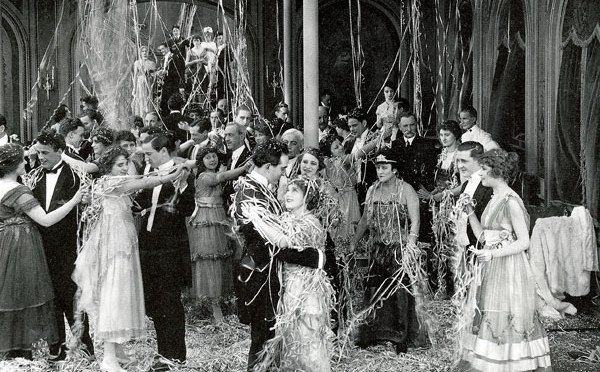
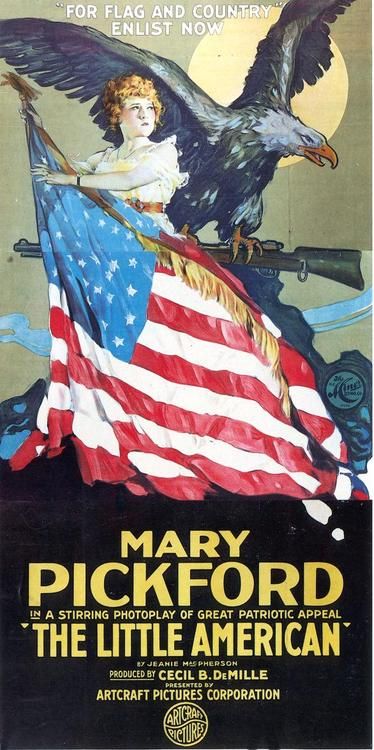
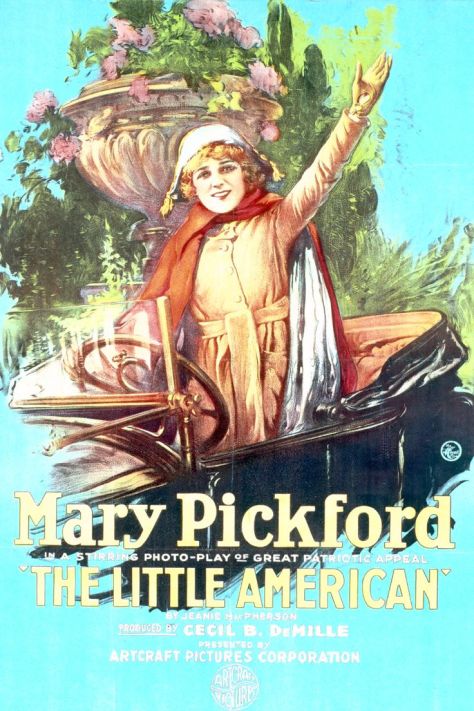
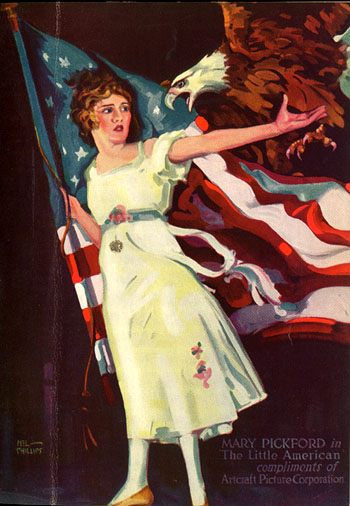
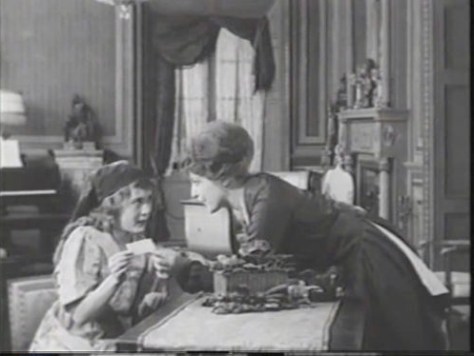
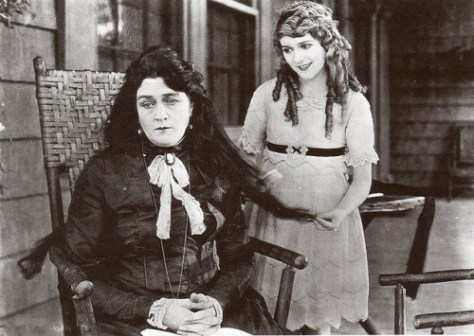
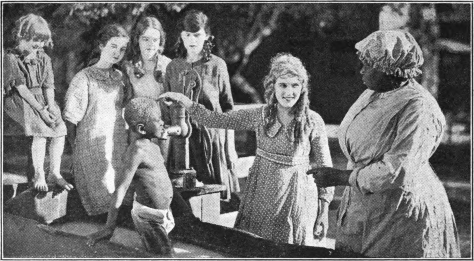
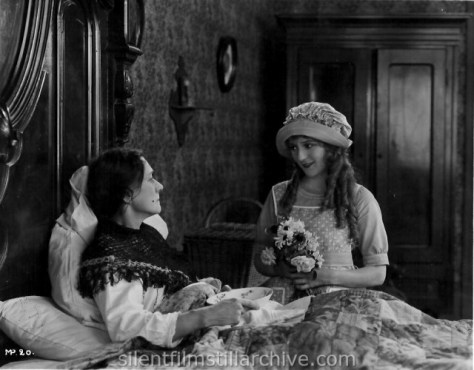
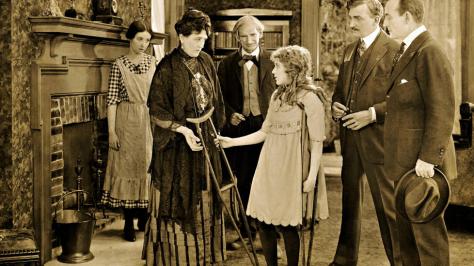
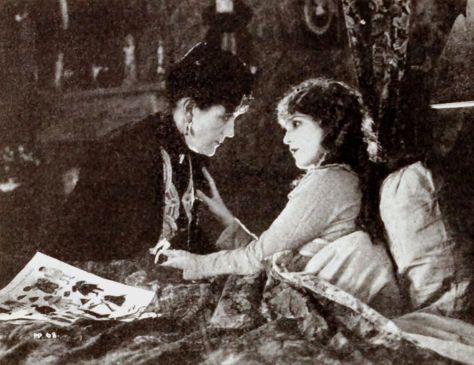
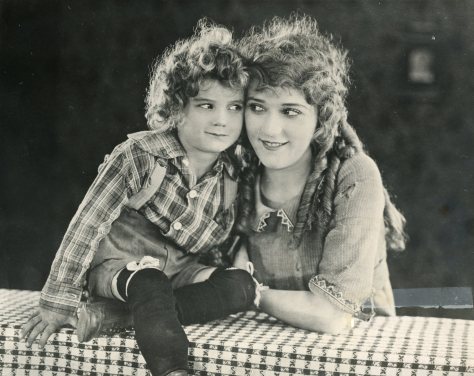
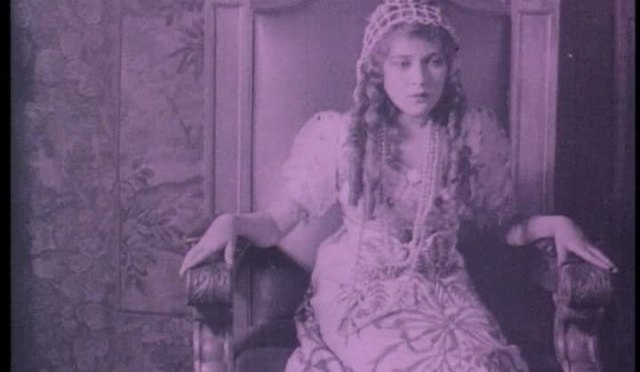
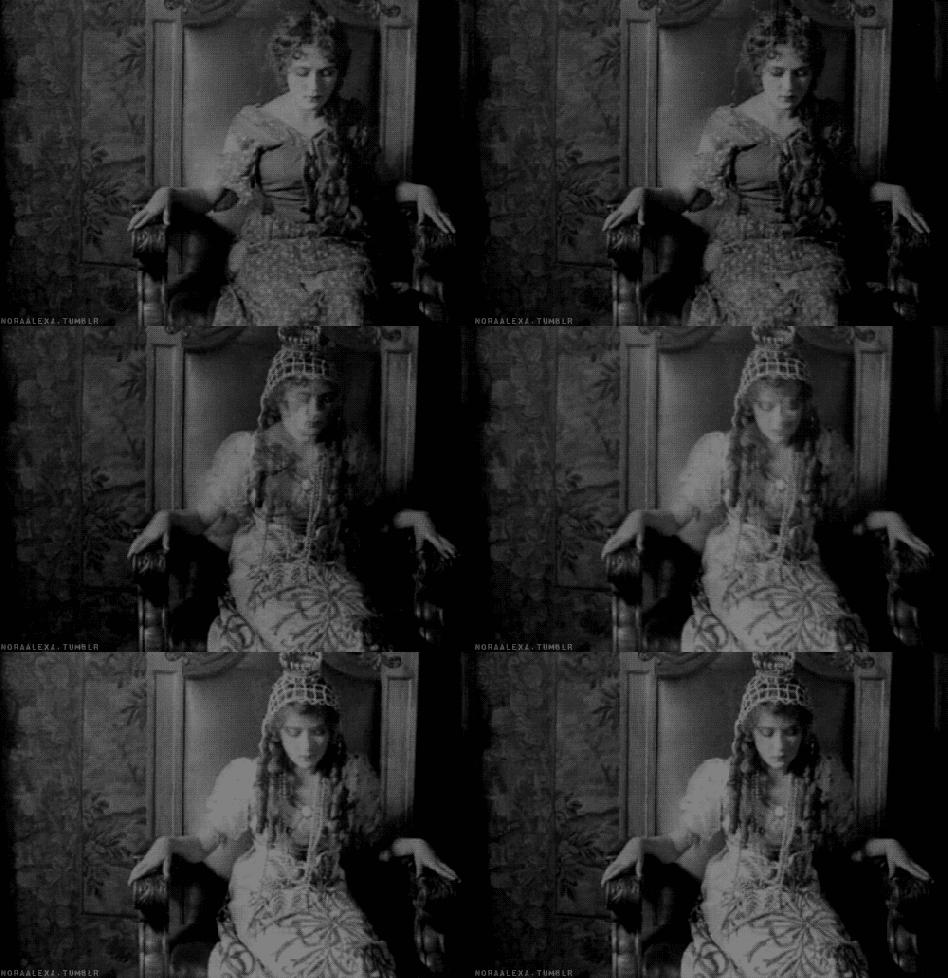
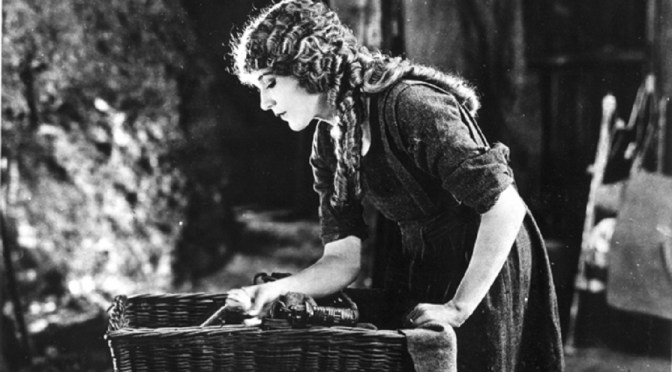
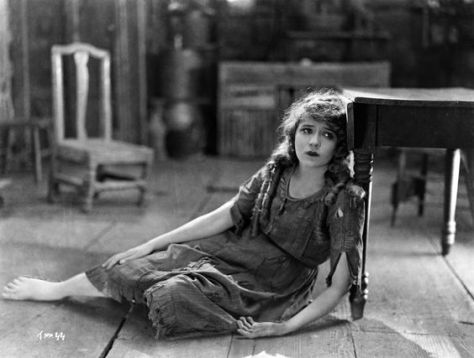
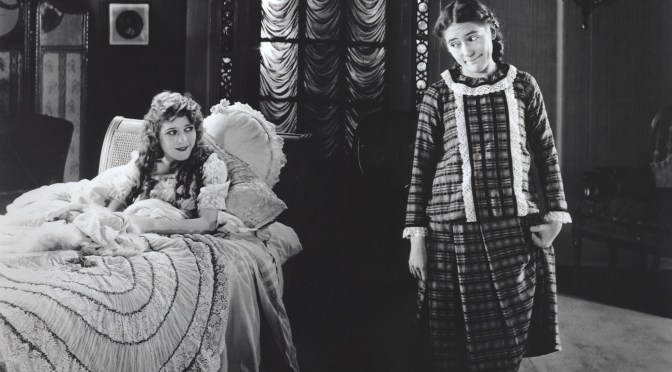
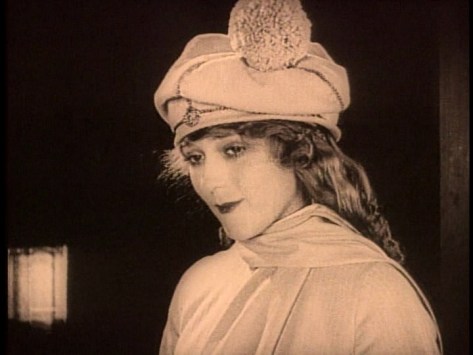
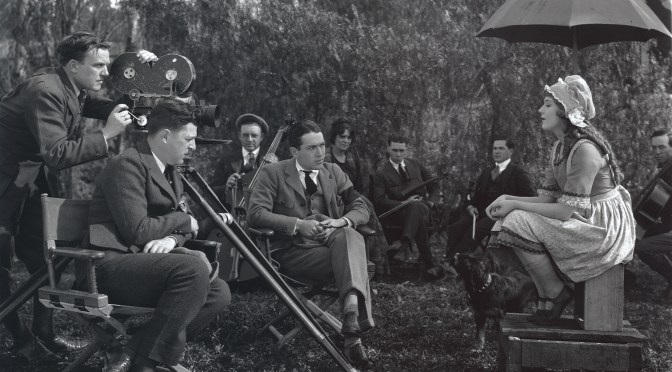
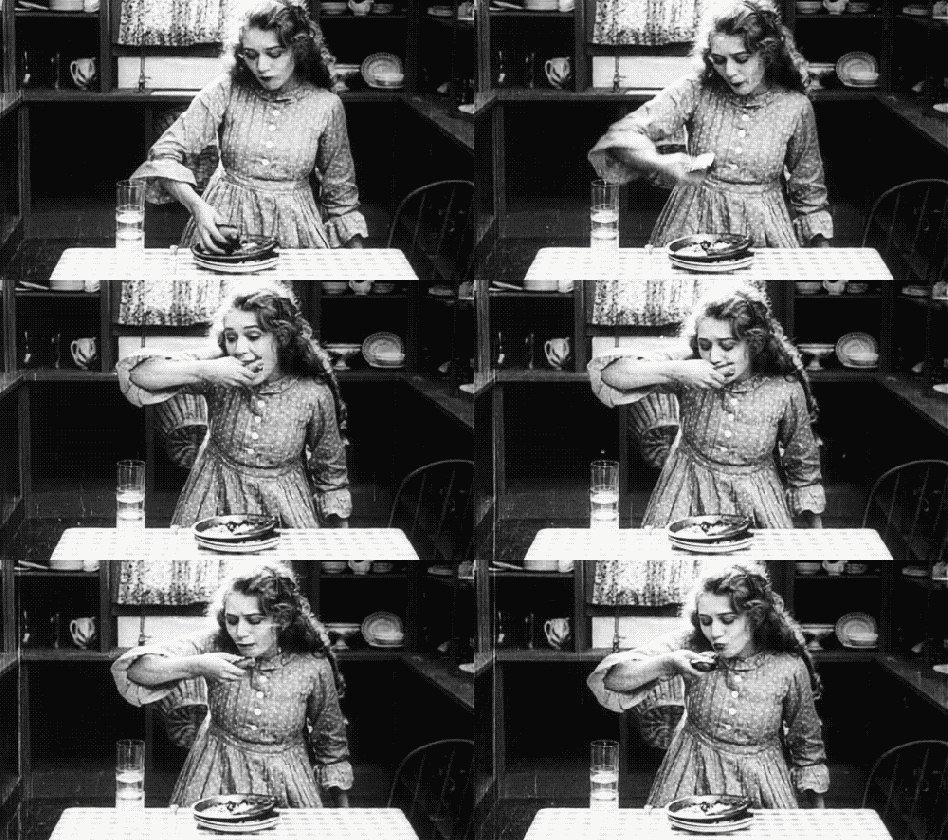
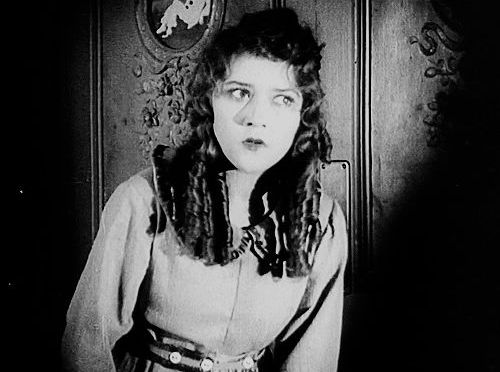
The Little American is a 1917 American silent romantic war drama film directed by Cecil B. DeMille. The film stars Mary Pickford (who also served as producer) as an American woman who is in love with both a German and a French soldier during World War I. A print of the film is housed at the UCLA Film and Television Archive and has been released on DVD.[2]

Little American The 1917 7

Plot

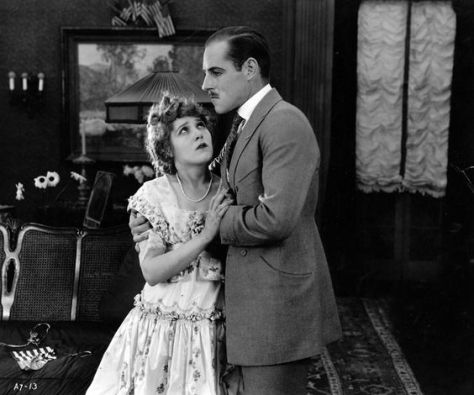
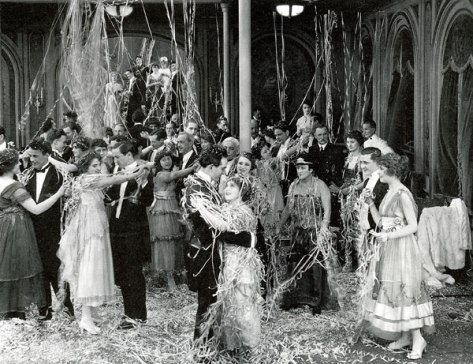
Karl Von Austreim (Jack Holt) lives in America with his German father and American mother. He notices a young lady, Angela More (Mary Pickford). As she is celebrating her birthday on the Fourth of July of 1914, she receives flowers from the French Count Jules De Destin (Raymond Hatton). They are interrupted by Karl, who also gives her a present. They soon battle for Angela’s attention. To lose his competition, Count Jules arranges for Karl to be sent to Hamburg, where he will have to join his regiment. Angela is crushed when he announces he has to leave. The next day, Angela reads in the paper the Germans and French are at war and 10,000 Germans have been killed already.

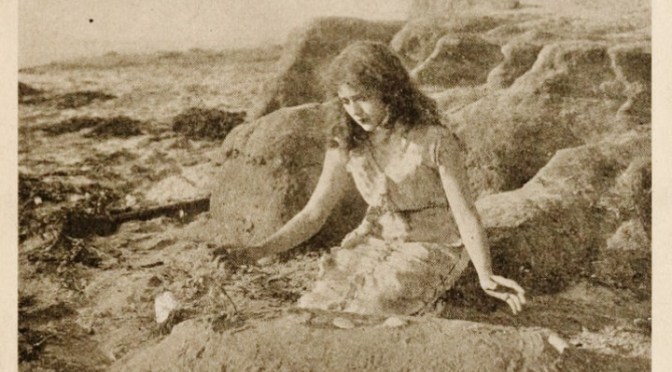
Three months pass by without a word from Karl. Karl is wounded in the fighting. Word spreads that Germany will sink any ship which is thought to be carrying munitions to the Allies. Angela is aboard one of those ships when it is hit. Angela saves herself by climbing on a floating table and begging the attackers not to fire on the passengers. Angela is eventually rescued.

Little American The 1917 11

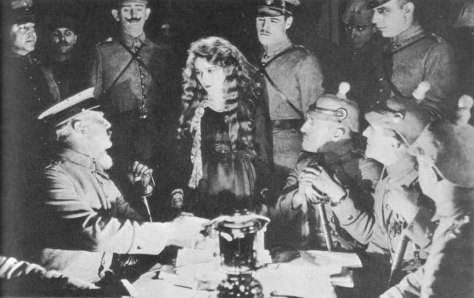
After weeks of ceaseless hammering from the German guns, the French fall back on Vangy. Angela arrives in Vangy as well to visit her aunt, only to discover she has died. The Old Prussians are bombing the city and Angela is requested to flee. However, she is determined to stay to nurse the wounded soldiers. Meanwhile, the Germans enter the chateau with the intention of getting drunk and enjoying themselves with the young women. A French soldier tries to help Angela escape, but she is unwilling to. He next asks her to let a French soldier spy on the Germans and inform the French via a secret hidden telephone. Angela is afraid, but gives them permission.

The Germans are intent on raping Angela, who is the only person in the mansion not to be hidden. She reveals herself to be an American to save herself, but they do not believe her. Angela attempts to run away and hide, but is discovered by a German soldier who turns out to be Karl. Angela orders him to save the other women in the house, but Karl responds he cannot give orders to his fellow Germans. She realizes there is nothing she can do. With permission to leave the mansion, she witnesses the execution of the French soldiers. She is heartbroken and decides to go back in for revenge.

Angela secretly calls the French with the hidden telephone and informs them that there are three gun holders near the chateau. The French prepare themselves and attack the Germans. The Germans realize someone is giving the French information and Karl catches Angela. He tries to help her escape, but they are caught. The commander orders that Angela be shot. When Karl tries to save her, he is to sentenced to be executed as well for treason. As the couple face death, the French bomb the mansion, enabling Angela and Karl to escape. They are too weak to run and collapse near a statue of Jesus. The next day, they are found by French soldiers. They initially want to shoot Karl, but Angela begs them to set him free. They eventually allow her to fly back to America with Karl by her side as a German prisoner.

Little American The 1917 9

Cast

Reception

Although the United States had entered World War I and declared war on Germany earlier in 1917, the Chicago Board of Censors initially blocked exhibition of the film in that city, calling it anti-German and suggesting that showing it could start a riot.[3] Artcraft challenged the Board in state court and, after a jury trial, the refusal of the board to issue a permit despite a court order, and the denial of a second appeal by the board, won the right to show the film in Chicago.[4]

Little American The 1917 9

See also

References

  1. ^ Jump up to:a b Birchard, Robert S. (2009). “25”. Cecil B. DeMille’s Hollywood. University Press of Kentucky. ISBN 0-813-13829-9.
  2. Jump up^ The Little American at the silentera.com database
  3. Jump up^ “Chicago Censors Call “Little American” Anti-German and Block Exhibition”. Exhibitors Herald. New York City: Exhibitors Herald Company. 5 (3): 13. 14 July 1917. Retrieved 2014-11-07.
  4. Jump up^ “Pickford Film Wins in Chicago Over Funkhouser”. Exhibitors Herald. New York City: Exhibitors Herald Company. 5 (6): 17. 8 August 1917. Retrieved 2014-11-07.

Little American The 1917 12

Suds (1920)


Mary Pickford 1

Mary Pickford Season: FD Cinematheque

Suds (1920)

Director: John Francis Dillon

Cast: Mary Pickford, Albert Austin, Harold Goodwin, Rose Dione, Darwin Karr, Lavendor the Horse, Taylor N Duncan, Joan Marsh, Nadyne Montgomery, Theodore Roberts, Hal Wilson

75 min

Suds 1

Suds 6


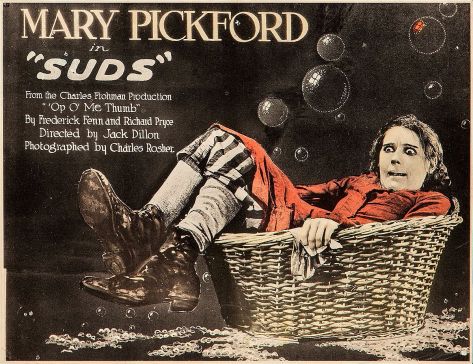
Suds is a 1920 American silent comedy film directed by John Francis Dillon and starring Mary Pickford. The film is based on the 1904 English stage play ‘Op o’ Me Thumb, a one-act work first produced in London and presented the following year in New York with Maude Adams, a curtain raiser for her appearance in Peter Pan.[2]

Suds 4

Plot

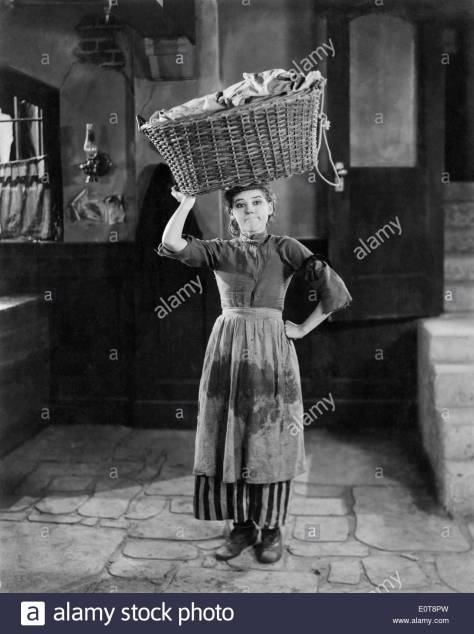
Amanda Afflick (Mary Pickford) is a poor laundry woman working in London. She is too weak to do the hard work, but is always picked on and humiliated by her boss Madame Didier (Rose Dione). Amanda is desperately in love with the handsome customer Horace Greensmith (Albert Austin), but none of her colleague think she stands a chance of being his sweetheart.

One afternoon Amanda gets in trouble again and is forced to work all night long. All alone, she fantasizes about her first and only meeting with Horace, eight months ago. All the fellow employees ridicule her for still having faith that he will return someday to pick up his clothes. Amanda is fed up with all her colleagues making fun of her and lies that she is a duchess, coming from a wealthy family. She comes up with a story of her having an affair with Horace. Her father found out and sent her to live in London.

Meanwhile, co-worker Benjamin Jones (Harold Goodwin) has the job of collecting laundry with his cart. One day, his beloved horse Lavender is too weak to go up a hill and falls. The cart is destroyed and when Benjamin admits the truth to Madame Didier, she asks for the horse to be killed. Benjamin reveals to Amanda what will happen with Lavender and she tries to stop the horse from being killed. She eventually buys the horse and takes it into her own home.

Amanda is not allowed to take the horse into her own apartment and is noticed on the streets by the wealthy and sympathizing Lady Burke-Cavendish. She offers to take the horse to live at her country place. Amanda is delighted and accepts her offer. Later, Lady Burke-Cavendish stops by to tell Amanda the horse is doing very well. Amanda lies to the fellow laundry women Lady Burke-Cavendish is actually her aunt.

They are interrupted by Horace: he has returned for his laundry. The fellow workers assume he will recognize Amanda, since they were lied to he is her secret lover. Amanda is desperate and successfully pretends to be reunited with him. Horace is confused and wants to leave. While the laundry women are away she tells the truth to Horace. Benjamin walks in on them, initially trying to flirt with Amanda , but when he notices Horace’s presence he leaves.

Horace sympathizes with Amanda and invites her to his mansion. He changes his mind when he becomes ashamed of her. Amanda notices this and pulls back. Horace leaves and Amanda is left behind with a broken heart. She is later hired as Lady Burke-Cavendish’s personal maid and now lives in wealth. She finds out Horace is a worker at the country place and they fall in love with each other.

Suds 3

Remake

The original film was adapted to a musical written by Deonn Ritchie Hunt with music by Kim Douglas in the 2000s.

Cast

  • Mary Pickford as Amanda Afflick
  • Albert Austin as Horace Greensmith
  • Harold Goodwin as Benjamin Pillsbury Jones
  • Rose Dione as Madame Jeanne Gallifilet Didier
  • Darwin Karr as The Archduke
  • Taylor N. Duncan (undetermined role) (uncredited)
  • Joan Marsh (undetermined role) (uncredited)
  • Nadyne Montgomery (undetermined role) (uncredited)
  • Theodore Roberts (undetermined role) (uncredited)
  • Hal Wilson (undetermined role) (uncredited)

Suds 5

Production crew

  • Produced by Mary Pickford
  • Cinematography by L. William O’Connell and Charles Rosher
  • Art Direction by Max Parker
  • Costume Design by Adele Crinley
  • Assistant Director William A. Crinley
  • Art Department – Alfred L. Werker (props)
  • Other crew – William S. Johnson (electrical effects)

See also

References

Kiki (1931)


Mary Pickford 1

Mary Pickford Season: FD Cinematheque

Kiki (1931)

Director: Sam Taylor

Cast: Mary Pickford, Reginald Denny, Joseph Cawthorn, Margaret Livingston, Phil Tead, Fred Walton, Edwin Maxwell, George Davis, Betty Grable (uncredited), Edmund Mortimer, Fred Warren, Blue Washington

87 min

Kiki 2


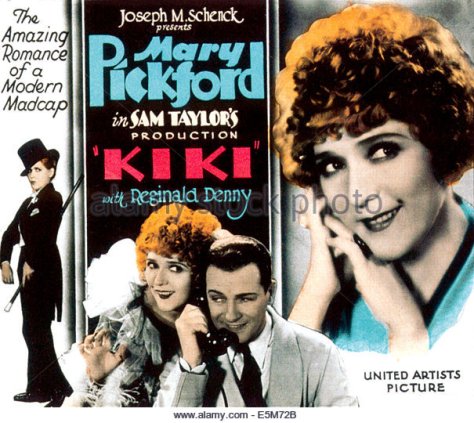
Kiki is a 1931 American Pre-Code romantic comedy, starring Mary Pickford and Reginald Denny, which was directed by Sam Taylor. The film is a remake of the 1926 version starring Norma Talmadge.

Plot

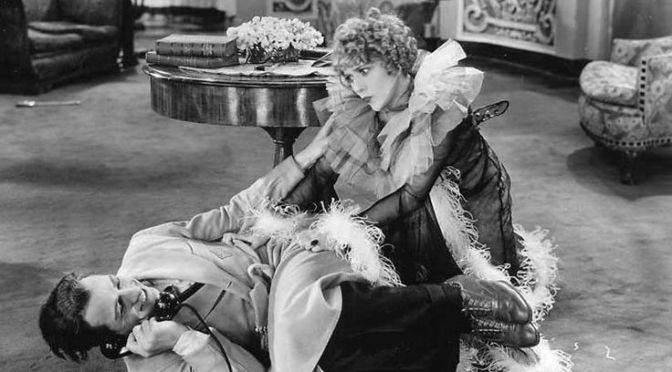
Kiki (Mary Pickford) is a hapless French chorus girl who has just been fired from her job. She doesn’t accept it and goes to see producer Victor Randall (Reginald Denny). He, however, is really busy and is annoyed by her presence. To get her out of his office, he promises her job back. Before she leaves, she drops her purse and clippings of Victor shaped in hearts fall out. It becomes clear Kiki is secretly in love with him.

When the next show becomes a disaster because of Kiki, she is again fired. She goes complaining at Victor Randall’s office for the second time. He is now charmed by her and invites Kiki to his apartment. There, she notices a photo of his ex-wife Paulette Vaile (Margaret Livingston). He kisses her, but she is insulted and slaps him. She hides in another room and makes clear she feels used and thinks Victor is still not over Paulette.

She eventually falls asleep in the room and finds a letter from Paulette the next morning. Although it’s for Victor, she reads it. It says she is sorry about last night and wants to make up with Victor. Kiki becomes jealous and ruins the letter. Meanwhile, the servants are irritated by Kiki and try to get her out of Victor’s apartment. Victor confronts her when the servants inform him Kiki has stolen a few of Paulette’s letters. He eventtually finds the letters and reads them.

Victor and Kiki have a conversation and flirt for the first time. Kiki becomes angry when Victor receives a phone call from Paulette and answers it. Paulette later visits Victor’s apartment. Kiki is outraged and tells Paulette she is in love with Victor and intends to marry him. Victor catches Kiki intimidating and scaring Paulette and orders her to get out.

Victor and Paulette fall in love with each other again, but they find out Kiki hasn’t left the apartment. Kiki pretends to be unconscious. Victor puts her in bed to rest and Kiki kisses him. He tells Paulette he can’t leave Kiki alone. Paulette feels betrayed and leaves him. Victor and Kiki finally fall in love and kiss.

Kiki 6

Cast

Release

The film was released in 1931. New York Times film critic Mordaunt Hall credited the film for its comedy and characterizations of the stars in the movie; however longtime Pickford fans were not used to the loose adult role that the star traded for her earlier ingenuousness and it eventually flopped at the box office.[2]

A copy of the film still exists at the UCLA Film and Television Archive. However, it has not been released on home video or DVD, the only Mary Pickford talkie not to be released.

It was the first Mary Pickford film since the formation of United Artists to lose money.[1]

References

  1. ^ Jump up to:a b Balio, Tino (2009). United Artists: The Company Built by the Stars. University of Wisconsin Press. ISBN 978-0-299-23004-3. p93
  2. Jump up^ The New York Times Review

Kiki 11

Taming of the Shrew, The (1929)


Mary Pickford 1Mary Pickford Season: FD Cinematheque

Taming of the Shrew, The (1929)

Director: Sam Taylor

Cast: Mary Pickford, Douglas Fairbanks, Edwin Maxwell, Joseph Cawthorn, Clyde Cook, Geoffrey Wardwell, Dorothy Jordan, Frankie Genardi, Charles Stevens

63 min

Taming of the Shrew 1929 2

Taming of the Shrew 1929 3


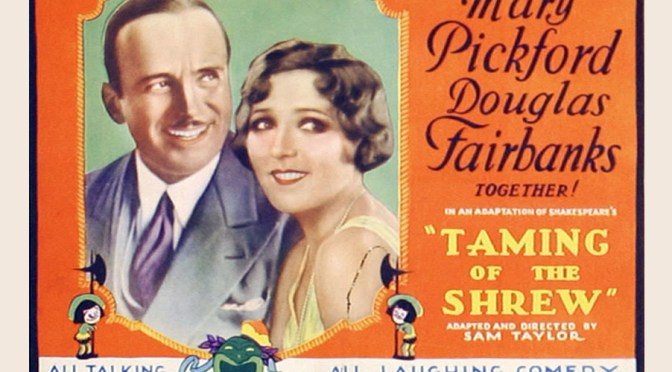
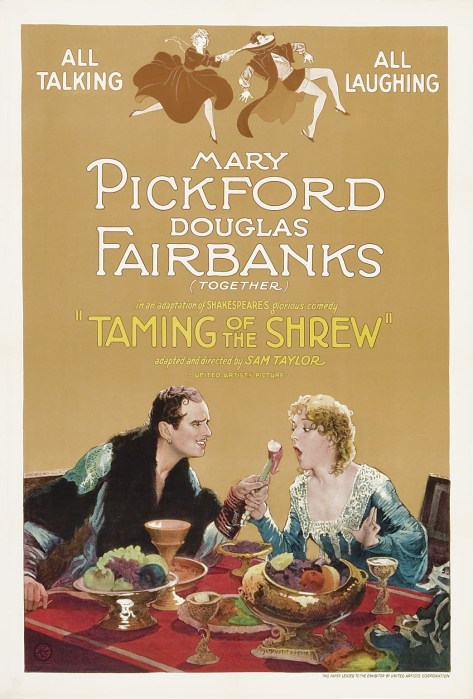
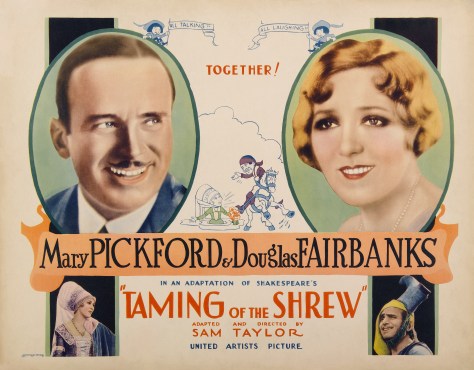
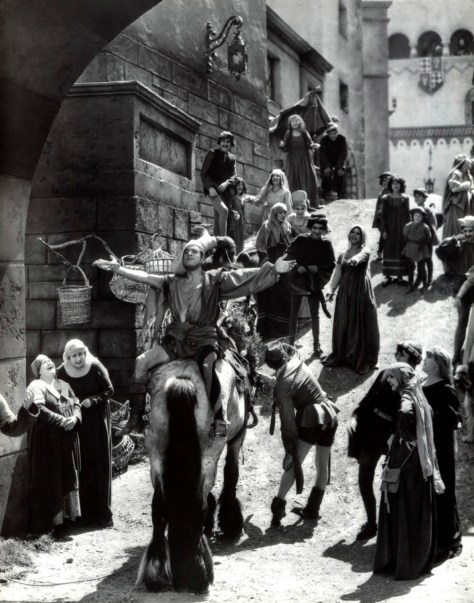
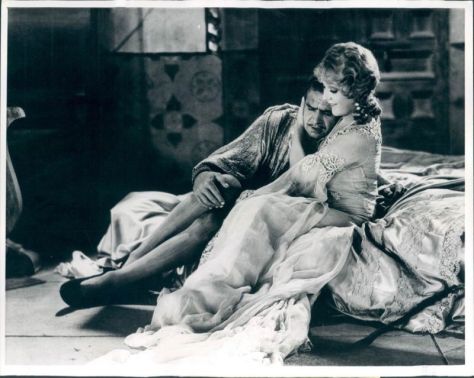
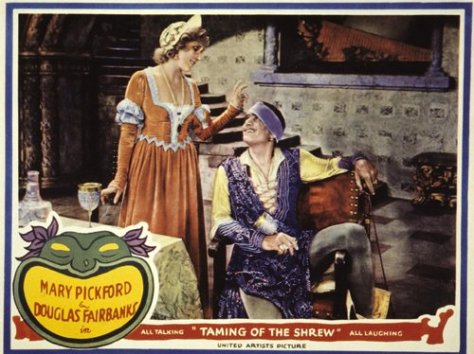
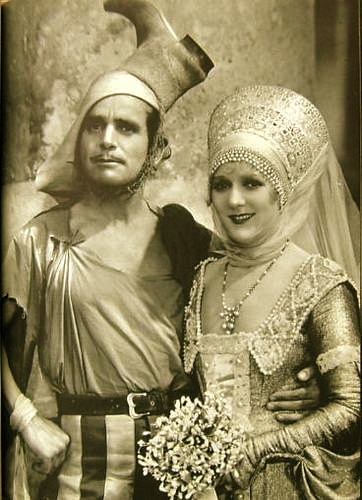
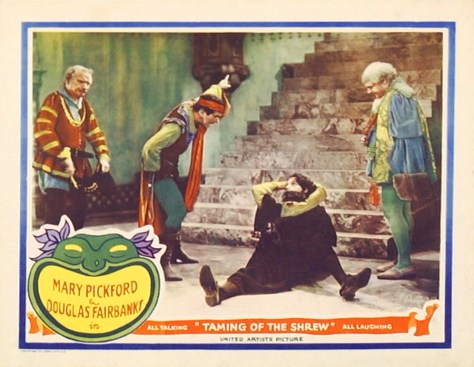
The Taming of the Shrew (1929) is the first sound film adaptation of the Shakespearean play of the same name. The movie was directed by Sam Taylor, adapted by Taylor from William Shakespeare‘s play, and stars Mary Pickford and her husband Douglas Fairbanks.

Douglas Fairbanks 1929 - The Taming of the Shrew

Cast

Taming of the Shrew 1929 21

Production

The first sound version of the play on film, this version was planned as a sound film from the start. Pickford had already made her sound film debut in Coquette (1929) so The Taming of the Shrew marked her second talkie. [1] This version of the film is primarily known for how Pickford delivers Katherina’s last speech. As she moves though the litany of reasons why a woman should obey her husband, she winks toward Bianca, unseen by Petruchio. Bianca smiles in silent communication with Katherina, thus acknowledging that Katherina has not been tamed at all. Pickford and Fairbanks’ marriage was breaking down even before filming began, and animosity between the couple increased during filming. In later years, Pickford stated that working on the film was the worst experience of her life, although she also acknowledged that Fairbanks’ performance was one of his best.

Taming of the Shrew 1929 19

Reception

Fairbanks biographer Jeffrey Vance, writing in 2008, believes “Taming of the Shrew has never received the recognition it deserves as the first talking film of a Shakespeare play. It was not only technically superior to the majority of talking pictures in 1929 but would unquestionably be the finest translation onto film of Shakespeare for some time to come.” Vance also sees the film as a window into the Pickford-Fairbanks marriage: “As a reenactment of the Pickford-Fairbanks marriage, Taming of the Shrew continues to fascinate as a rather grim comedy. The two willful, larger-than-life personalities working at cross-purposes and conveying their resentment and frustration to each other through blatant one-upmanship and harsh wounds is both the movie and the marital union.” [2]

Taming of the Shrew 1929 10

Home media

After many years out of circulation, the film was re-released in 1966 in a new cut supervised by Pickford herself. New sound effects and music were added throughout, much of the voice dubbing was enhanced with newly available technology, and seven minutes were cut from the initial print. This re-released version is the only version now available on DVD or VHS.[3]

Taming of the Shrew 1929 17

References

  1. Jump up^ John C. Tibbetts; James M. Welsh. Douglas Fairbanks and the American Century. Books.google.com. p. 225. Retrieved 2016-11-02.
  2. Jump up^ Vance, Jeffrey. Douglas Fairbanks (Berkeley, 2008), 280.ISBN 978-0-520-25667-5.
  3. Jump up^ Aikman Archive DVD booklet

Taming of the Shrew 1929 4

M’Liss (1918)


Mary Pickford 1

Mary Pickford Season: FD Cinematheque

M’Liss (1918)

Director: Marshall Neilan

Cast: Mary Pickford, Theodore Roberts, Thomas Meighan, Tully Marshall, Charles Ogle, Monte Blue, Winifred Greenwood, Helen Kelly, Val Paul, William H Brown, John Burton, Charles A Post, Guy Oliver, Steve Murphy, Harry L Rattenberry, Charles Stevens

73 min

M'Liss 1918 1

M'Liss 1918 2


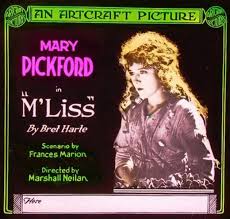
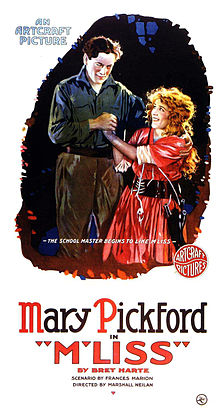
M’Liss is a 1918 American silent film directed by Marshall Neilan, written by Frances Marion and based on a Bret Harte story. The film was made previously in 1915 and was remade again in 1922 as The Girl Who Ran Wild, starring Gladys Walton. Another same-titled remake was released in 1936, starring Anne Shirley.

M'Liss 1918 7

Plot

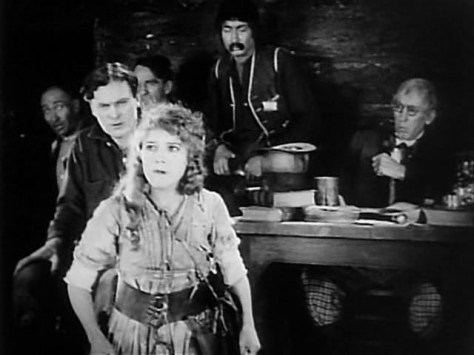
The film takes place in the mining town of Red Gulch in the High Sierra. M’Liss (Mary Pickford) is one of the inhabitants whose father “Bummer” (Theodore Roberts) lost his fortune in the gold mines. Now his only investment, which pays a dividend, is his chicken Hildegarde. M’Liss regards herself as a crook and robs Yuba Bill’s stage coach. Yuba, however, is fascinated by the young lady and does not mind.

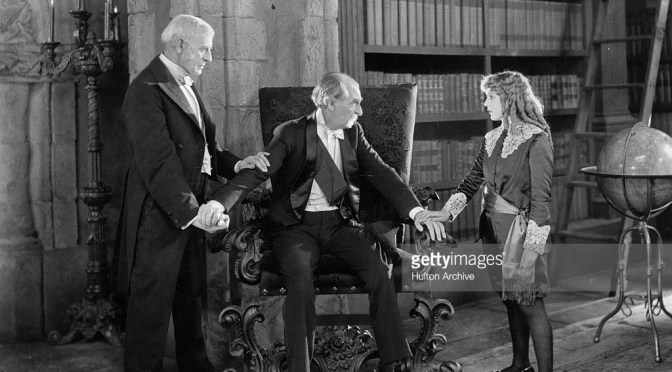
M’Liss is the only person in Bummer’s life, since his brother Jonathan, a wealthy pioneer, lives in San Francisco. One day, Jonathan turns his face toward the Sunset Trail. Clara Peterson (Winifred Goodwin) has been his nurse for over three years and her brother Jim (Val Paul) finds out they will receive $500 each for their services after his death. He is outraged they will get only that small amount of money.

Charles Gray (Thomas Meighan) is the school teacher who wants M’Liss to go to school as well. M’Liss isn’t interested in an education. Charles keeps on pursuing her and she finally decides to go. He demands her to mind her manners when she’s at school. She talks back to the boards members and is expelled. Charles, however, is charmed by the brave young girl. That same day, Bummer gets stabbed in the back by an unknown person. The sheriff suspects Charles, since he was the last person to visit Bummer.

When M’Liss is informed, she is crushed. She is invited to visit the murderer in jail and is shocked to find out it’s Charles. Three weeks later, a murder trial starts. M’Liss is the only one believing in Charles’ innocence. His wife Clara reaches town to visit him, only to find out he died. M’Liss refuses to believe she is her mother. Finally, Charles is sent to jail for 60 years. M’Liss helps him escape, but the police follow him. M’Liss witnesses them shooting Charles, but does not know they went after the wrong guy and actually shot Jim. Jim and Mexican Joe, the help of the sheriff, admit they killed Bummer for his will. The fortune is now send to M’Liss and a hidden Charles is set free and reunites with M’Liss.

M'Liss 1918 6

Cast

Reception

Like many American films of the time, M’Liss was subject to cuts by city and state film censorship boards. For example, the Chicago Board of Censors required cuts, in Reel 5, of the intertitle “Say, sheriff, how about a little necktie party” and the scene of the sheriff looking up tree and dropping rope.[3]

References

  1. Jump up^ The New York Times Review Remakes
  2. Jump up^ Progressive Silent Film List: M’Liss at silentera.com
  3. Jump up^ “Official Cut-Outs by the Chicago Board of Censors”. Exhibitors Herald. New York City: Exhibitors Herald Company. 6 (21): 31. May 18, 1918.

M'Liss 1918 11

Little Lord Fountleroy (1921)


Mary Pickford 1

Mary Pickford Season: FD Cinematheque

Little Lord Fountleroy (1921)

Director: Alfred E Green and Jack Pickford

Cast: Mary Pickford, Claude Gillingwater, Joseph J Dowling, James A Marcus, Kate Price, Fred Malatesta, Rose Dione, Arthur Thalasso, Colin Kenny, Emmett King, Madame De Bodamere, Jackie Condon, Gordon Griffith

112 min

Little Lord Fountleroy 3

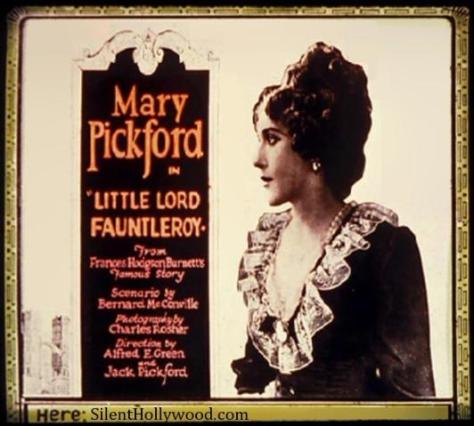
Little Lord Fauntleroy is a 1921 American silent drama film directed by Alfred E. Green and Jack Pickford and starred the latter’s elder sister Mary Pickford as both Cedric Errol and Widow Errol. The film is based on the 1886 novel of the same name by Frances Hodgson Burnett.[2] A statue depicting Pickford’s role exists today on the facade of New York City’s landmarked I. Miller Building.[3]

Little Lord Fountleroy 15

Plot summary

Cedric Errol is a poor American boy who finds out that he is the sole heir to a wealthy British earldom and thus becomes Lord Fauntleroy.

Little Lord Fountleroy 18

Cast

See also

References

  1. Jump up^ Balio, Tino (2009). United Artists: The Company Built By Stars. University of Wisconsin Press. ISBN 978-0-299-23004-3. p42
  2. Jump up^ “Little Lord Fauntleroy (1921)”. IMDb. Retrieved 2 March 2013.
  3. Jump up^ “In Times Square, a New Landmark: I. Miller Building, With 4 Calder Sculptures; There’s No Business Like Shoe Business”. New York Times. July 4, 1999. Retrieved 2014-01-29. And the winners were: for opera, Rosa Ponselle in the title role of Norma; for movies, Mary Pickford in the title role of Little Lord Fauntleroy (1921); for musical comedy, Marilyn Miller in the title role of Sunny (1925) and for drama, Ethel Barrymore as Ophelia, a non-title role.

Little Lord Fountleroy 13

Rosita (1923)


Mary Pickford 1

Mary Pickford Season: FD Cinematheque

Rosita (1913)

Dir: Ernst Lubitsch ( and Raoul Walsh – Uncredited )

Cast: Mary Pickford, Holbrook Blinn, Irene Rich, George Walsh, Charles Belcher, Frank Leigh, Mathilde Comont, George Priolat, Bert Sprotte, Snitz Edwards, Phillippe De Lacy

Rosita 1

Rosita 15

Rosita 3

Rosita 2 Rosita 13


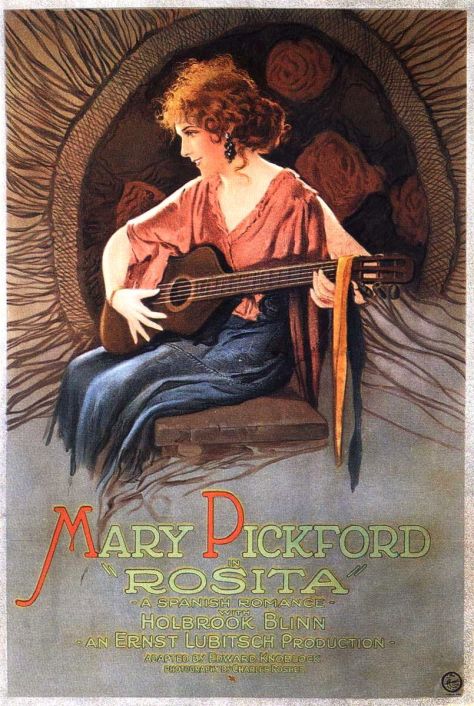
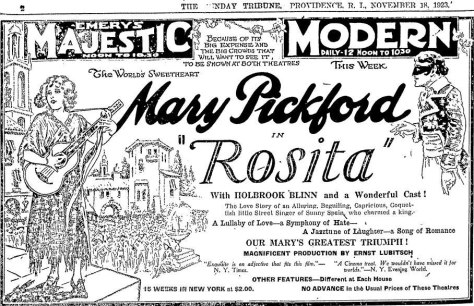
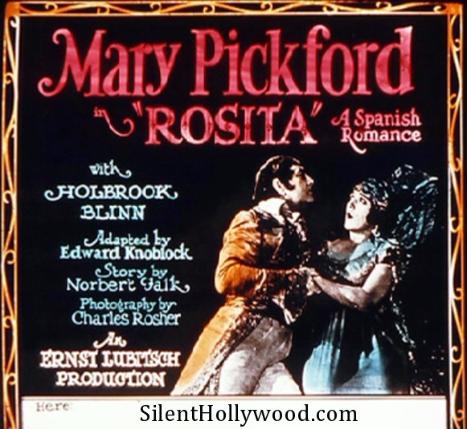
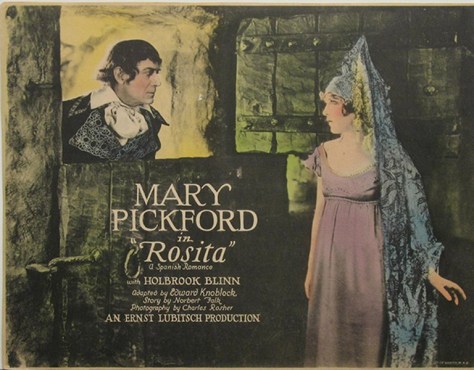
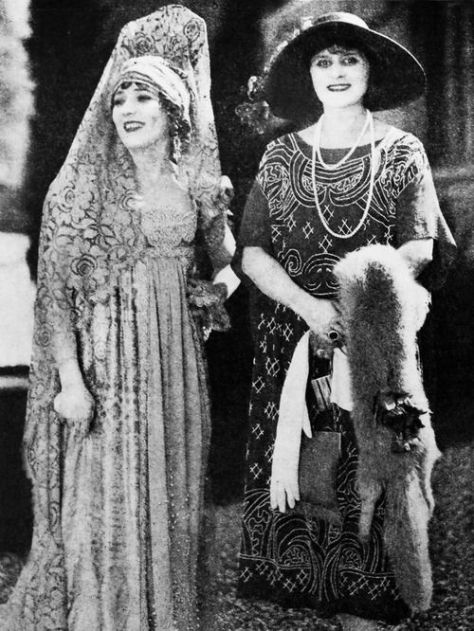
Rosita is a 1923 American silent film directed by Ernst Lubitsch. The film is based upon an 1872 opera Don César de Bazan of Adolphe d’Ennery et Philippe Dumanoir.

Rosita 8

Contents

Synopsis

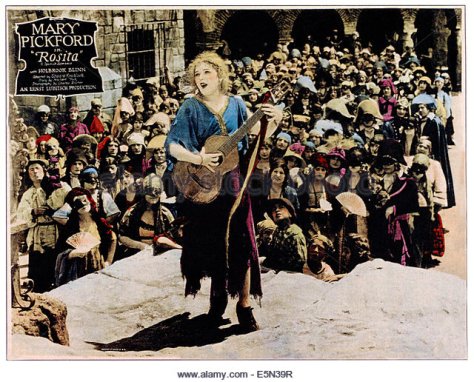
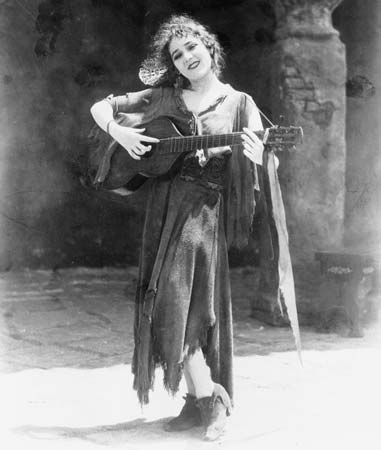
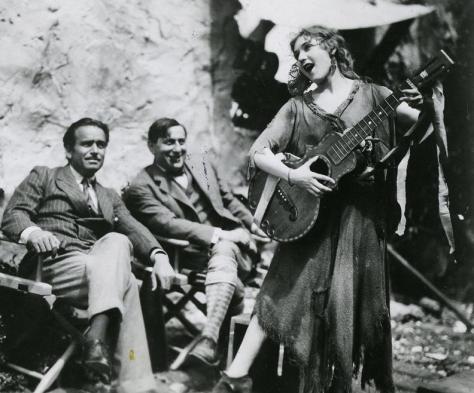
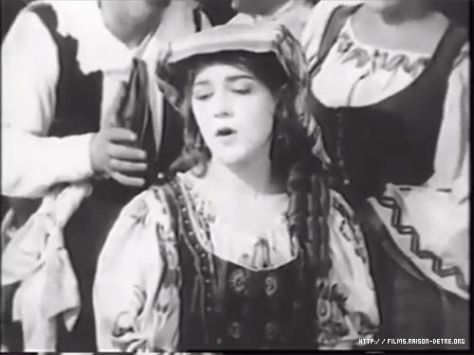
The film takes place in Seville, in a period where the city has sunk into the depths of depravity and sin. Shocked by the depths his people have sunk to, the king of Spain (Holbrook Blinn) decides to give the town a visit when a carnaval is organized in order to redeem it. One of its inhabitants is Rosita (Mary Pickford), a beloved street singer praised by the townspeople for her entertainment.

Rosita is the only source of income to her poor family, who are always fighting each other. She is fed up with living in extreme poverty, while the king is living in wealth. After being forced to pay taxes, Rosita is enraged and comes up with a song in which she insults the king. Soon, the king is informed with the offensive ballad and visits her anonymously. Instead of being angry, he is charmed by the woman. However, the soldiers have come to arrest her for publicly insulting the king.

While being taken to prison, Don Diego (George Walsh) tries to defend her. Instead of convincing the soldiers to set her free, however, he is arrested as well. They fall in love at the police station, but she is unaware Diego is a powerful captain. By the king’s request, Rosita is set free and escorted to his castle. Diego, however, is told he will be hung. When she meets him, Rosita doesn’t believe he is the king. He tries to seduce her, but she isn’t impressed until he offers her fashionable clothes. She doesn’t want to have anything to do with him, but is pressured into giving in on his advances by her family, who see an opportunity on becoming wealthy.

Living a luxurious life in the castle, the family still feels disrespected. Rosita’s mother (Mathilde Comont) demands for her daughter to have a noble husband, and the king offers her to be married to Diego. Rosita’s mother is pleased, not knowing he will be sentenced to death shortly after the wedding. Diego is manipulated into participating by the offer of being shot like a respectable soldier, rather than hanged. At the wedding, they are married with their eyes covered, thus not knowing who they will be married to. The king’s plan fails when Rosita breaks the rules and looks at her future husband.

Rosita is shocked to learn her new husband is Diego, who is sent back to jail immediately. Rosita convinces the king to set Diego free. However, when she leaves, the king again orders the guards to kill Diego. Meanwhile, the queen (Irene Rich) has found out about his new fling and is furious.

Soon afterward, Rosita is informed that Diego has been executed. Devastated, she attempts to kill the king until she and the king find out Diego is still alive, and the lovers are reunited. The king leaves his castle to be confronted by his wife about his affair. She reveals she ordered the guards to spare Diego.

Rosita 4

Cast

Rosita 10

Production

Prior to this movie, Mary Pickford mostly appeared in features portraying children. Pickford appealed to a fan magazine for new film ideas, and the magazine’s contributors wrote back that they wanted to see her play more child roles, such as Cinderella. Pickford thanked them and promptly set out to make a film with an adult role.

In 1922, her studio United Artists was not making any profits, despite releasing successful films such as Broken Blossoms, Little Lord Fauntleroy (1921) and Robin Hood (1922). Pickford was desperate to release a film which could perform well and free her of her image as an ingenue.

Realizing Hollywood was making profits and costume movies, such as When Knighthood Was in Flower she decided to make a film based on the 1902 novel Dorothy Vernon of Haddon Hall. She chose Ernst Lubitsch as her director and brought him over from Germany in October 1922 to meet with her.[2]

Lubitsch decided he could not make Dorothy Vernon of Haddon Hall. Pickford was annoyed, since she had already paid $250,000 on its preparations (and would eventually film the story later on). They looked for another story to make a movie out of, ultimately choosing Faust. However, the project was dropped when Pickford’s mother, Charlotte Hennessy, overheard Lubitsch discussing the baby killing scene and immediately nixed the idea. Lubitsch and Pickford eventually decided to film the opera Don César de Bazan, retitling it as Rosita. Lubitsch hesitated about making it, but Pickford eventually convinced him to work on the project.[3]

Pickford wanted Ramón Novarro to co-star opposite her as Don Diego. Rex Ingram, Navarro’s mentor, protested to this offer, reminding Novarro that Pickford once stated that Novarro’s “face and body do not match”.[4] Novarro followed Ingram’s advice and rejected the role.

Lubitsch later said working with Pickford was a delight. Pickford also enjoyed working with Lubitsch, and at first contracted him to make three more movies with her.[5]

Rosita 14

Reception and release

After its release, the film became a huge success, earning over $1,000,000.[5] The movie was praised by both the critics and the audience. It eventually made profits for the studio.[6]

However, for reasons unknown Pickford decided the film was a failure.[7] She wanted the prints destroyed, and when she handed her films over for preservation she refused to hand over Rosita. However, another print was found.

See also

References

  1. Jump up^ Balio, Tino (2009). United Artists: The Company Built by the Stars. University of Wisconsin Press. ISBN 978-0-299-23004-3. p91
  2. Jump up^ Whitfield, Eileen: Pickford: the Woman Who Made Hollywood, pages 232-234 – ISBN 0-8131-2045-4
  3. Jump up^ Whitfield, Eileen: Pickford: the Woman Who Made Hollywood, pages 234-235 – ISBN 0-8131-2045-4
  4. Jump up^ Ellenberger, A., Ramon Novarro: a biography of the silent film idol, 1899-1968. p.26
  5. ^ Jump up to:a b Whitfield, Eileen: Pickford: the Woman Who Made Hollywood, page 238 – ISBN 0-8131-2045-4
  6. Jump up^ The New York Times Review
  7. Jump up^ Official website of Ernst Lubitsch Ernst Lubitsch biography

Rosita 6

Madame Butterfly (1915)


Mary Pickford 1

Mary Pickford Season: FD Cinematheque

Madame Butterfly (1915)

Dir: Sidney Olcott

Cast: Mary Pickford, Marshall Neilan, Olive West, Jane Hall, Lawrence Wood, Caroline Harris, M W Rale, William T Carleton, David Burton

61 min

Madame Butterfly 1

Madame Butterfly 2

Madame Butterfly 3

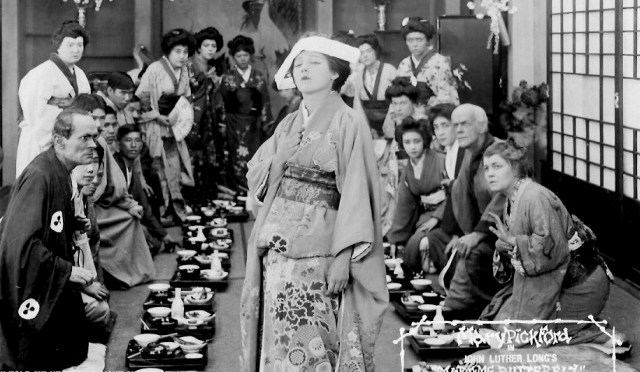
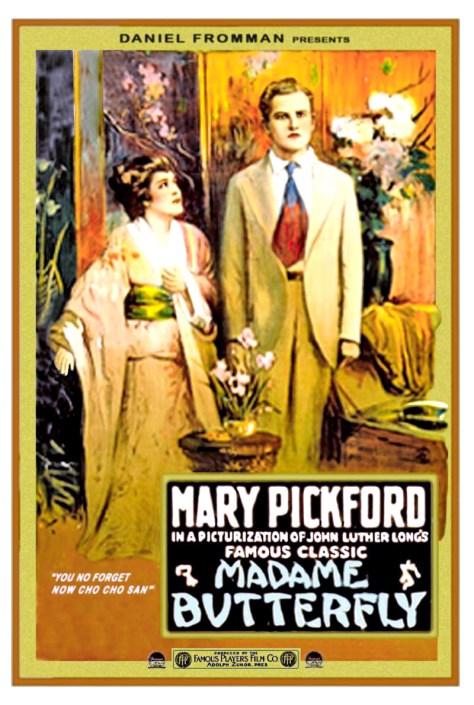
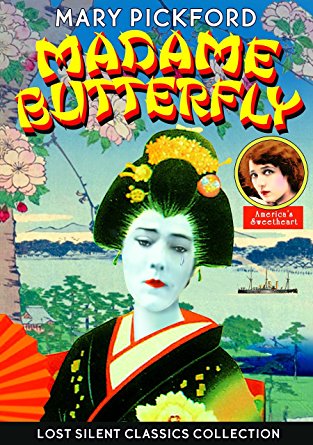
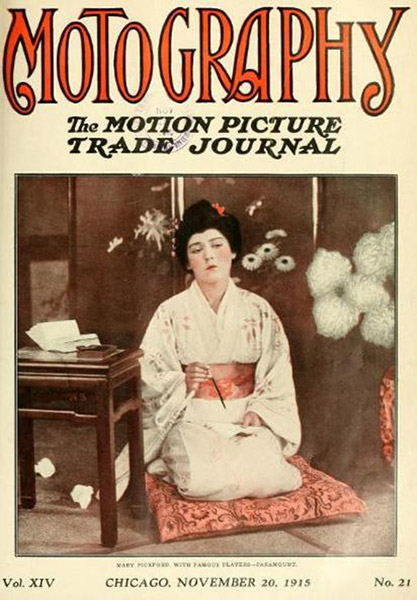
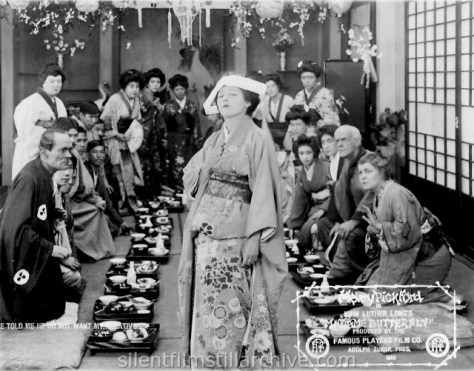
Madame Butterfly is a 1915 silent film directed by Sidney Olcott. The film is based upon a John Luther Long short story and the opera Madame Butterfly.

Production

Reportedly, leading actress Mary Pickford fought constantly with Sidney Olcott about the character. Olcott wanted Pickford to be more reserved and thought she was “too Americanized to play a Japanese”.[1]

Plot

The film takes place in Japan in 1904. Lieutenant Pinkerton (Marshall Neilan) marries Cho-Cho-San ‘Butterfly’ (Mary Pickford), a 15-year-old Japanese geisha. Cho-Cho-San is lucky with her new husband and takes the marriage very seriously. Pinkterton, however, regards it as entertainment. He is not in love with her and plans to break off the wedding in a month. The American Consul (William T. Carleton) begs him to break off the wedding as soon as possible, to avoid hurting her feelings. The lieutenant laughs him off.

After Pinkerton forces Cho-Cho-San to end their wedding reception early, her disapproving family disowns her. When Pinkerton is ordered to return to America, he promises Cho-Cho-San he will return before he leaves. Three years go by. Cho-Cho-San, now a mother, still believes Pinkerton will return someday, while he is engaged to an American woman. He sends her a letter to announce he will marry another woman, but Cho-Cho-San can’t read.

Meanwhile, The Prince of Japan (David Burton) takes interest in Cho-Cho-San, but she refuses his company and claims she is still waiting for her husband. Sometime later, Pinkerton returns to Japan but he hands the American Consul some money as compensation for Cho-Cho-San and leaves again. When Cho-Cho-San comes to ask about her husband, she runs into Pinkerton’s new American wife. The American woman asks Cho-Cho-San to give them her child, as he will be given better opportunities and prosperity under their parenting. Cho-Cho-San is crushed but complies and hands over her child. She kills herself in the final scene by walking into a river and drowning.

Cast

  • Mary Pickford – Cho-Cho-San
  • Marshall Neilan – Lieutenant Pinkerton
  • Olive West – Suzuki
  • Jane Hall – Adelaide
  • Lawrence Wood – Cho-Cho-San’s father
  • Caroline Harris – Cho-Cho-San’s mother
  • M.W. Rale – The Nakodo
  • William T. Carleton – The American Consul
  • David Burton – The Prince
  • Cesare Gravina – The Soothsayer
  • Frank Dekum – Naval officer

DVD release

Madame Butterfly was released on Region 0 DVD-R by Alpha Video on July 7, 2015.[2]

References

  1. Jump up^ Review on The New York Times
  2. Jump up^ “Alpha Video – Madame Butterfly (1915) (Silent)”. Retrieved 2015-06-26.
"He told me he do not want my relatives."
“He told me he do not want my relatives.”

Romance of the Redwoods, A (1917)


Mary Pickford 1

Mary Pickford Season: FD Cinematheque

Romance of the Redwoods, A (1917)

Dir: Cecil B DeMille

Cast: Mary Pickford, Elliott Dexter, Tully Marshall, Raymond Hatton, Charles Ogle, Walter Long, Winter Hall

70 min

Romance of the Redwoods 1 Romance of the Redwoods 9


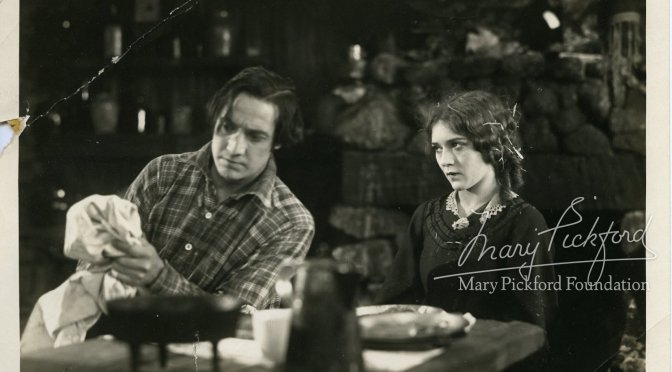
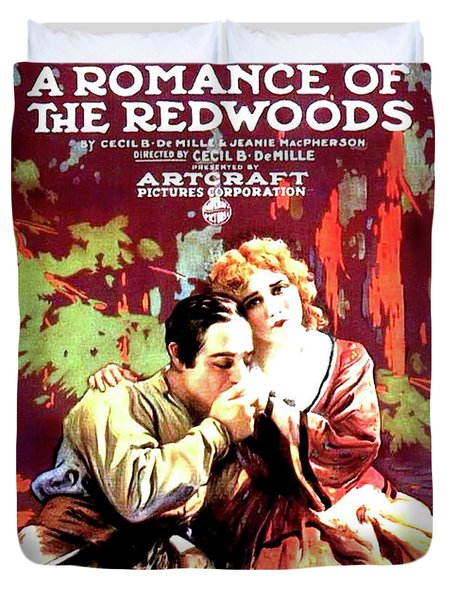
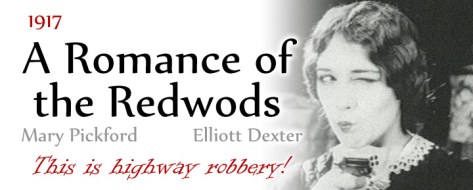
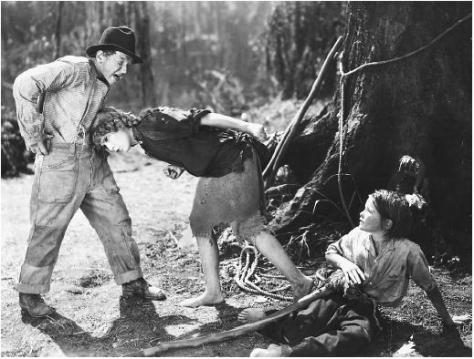
A Romance of the Redwoods is a 1917 American silent drama film directed by Cecil B. DeMille and starring Mary Pickford. A print of the film survives in the film archive at George Eastman House.[1]

Cast

Romance of the Redwoods 6

Sparrows 1926


Mary Pickford 1

Mary Pickford Season: FD Cinematheque

Sparrows 1926

Dir: William Beaudine and Tom McNamara

Cast; Mary Pickford, Roy Stewart, Mary Louise Miller, Gustav Von Seyffertitz, Charlotte Mineau, Spec O’Donnell, Lloyd Whitlock, Billy Butts, Monty O’Grady, Jackie Levine

84 min

Sparrows 1

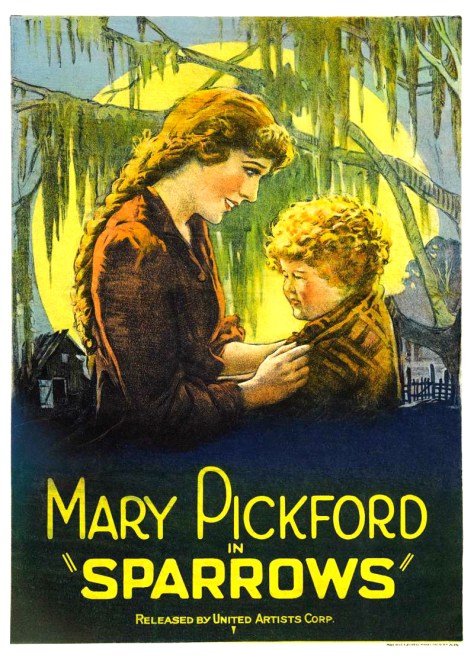
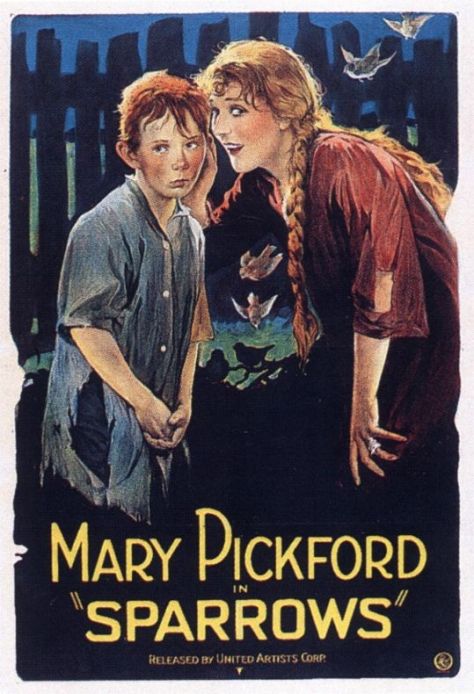
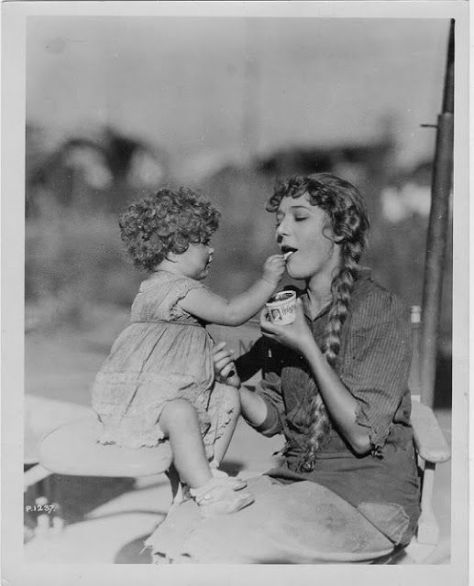
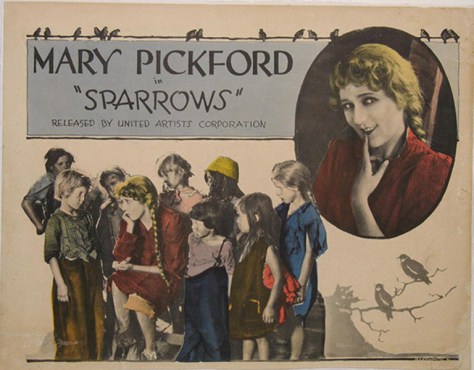
Sparrows is a 1926 American silent film about a young woman who rescues a baby from kidnappers. The film, which was originally titled Scraps, starred and was produced by Mary Pickford, who was the most powerful woman in Hollywood at the time.[1][2]

kinopoisk.ru

Plot

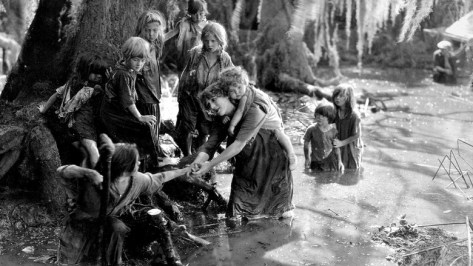
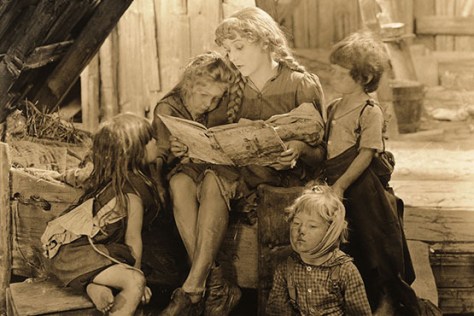
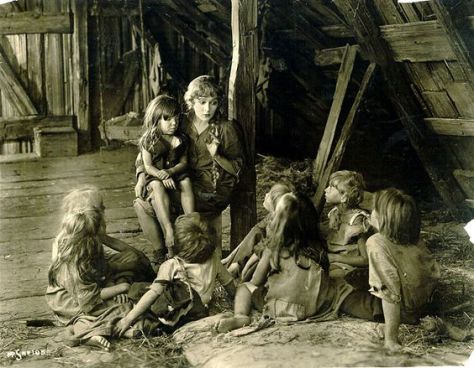
Mr. Grimes and his wife operate a dismal “baby farm” near an alligator-infested swamp. Molly, an adolescent inmate and the oldest of their charges, attempts to provide the other tattered, starving kids with the loving maternal care they need. Most of the children are orphans. One mother sends her child a doll, but Grimes crushes its head and tosses it into the swamp.

The children are ordered to hide anytime someone comes to the farm. When a hog buyer shows up, Ambrose, the Grimes’ son, maliciously prevents Splutters, one of the children, from hiding. The buyer then purchases the boy from Grimes.

Molly has promised the others that God will rescue them. When a boy asks why nothing has happened after a month, she tells him that He is busy attending to sparrows (a biblical reference).

Ambrose catches Molly with stolen potatoes, so she and the others are given no supper. She pleads for the children, especially the sick, youngest baby, to no avail. Late that night, in a vision, Christ enters the barn where they sleep and takes the baby. When Molly wakes up, the child is dead.

Joe Bailey and his associate bring a kidnapped baby girl to the farm for concealment until they receive a ransom from the rich father, Dennis Wayne. When Grimes reads about the kidnapping in the newspaper several days later, he decides it is safer to chuck the baby into the swamp.

When Ambrose grabs the little girl to carry out the plan, Molly gets her back. After she fights off Grimes with a pitchfork, he strands her in the hayloft and decides he must get rid of her, too.

That night, Molly flees with the children. Grimes finds this hilarious; he figures either the mud or the alligators will take care of the children. However, when the kidnappers come back for the baby, he leads them on a search.

Meanwhile, Splutters is brought to the police station, having been discovered by one of the search parties. He tells the policemen and Mr. Wayne about the baby farm.

Molly and the kids emerge unscathed from the swamp and hide aboard a boat, unaware it belongs to the kidnappers. Pursued by the police, Grimes runs into the swamp, but falls into deep mud and perishes, while the two criminals flee in the boat. Unable to shake the harbor patrol, they try to slip away in a dinghy, but are run over and drown.

The baby is reunited with her wealthy father, but when she refuses to drink her milk without Molly, Mr. Wayne offers Molly a comfortable home. She accepts only on condition that he take in the other children as well.

Cast

  • Children:
    • Billy Butts
    • Jack Lavine
    • Billy “Red” Jones
    • Muriel McCormac
    • Florence Rogan
    • Mary McLain
    • Sylvia Bernard
    • Seesel Ann Johnson
    • Camille Johnson

Sparrows 13

Cast notes:

  • Sparrows was Mary Pickford‘s next to last silent role; it was followed by 1927’s My Best Girl. After that, Pickford did some talking pictures before retiring to “Pickfair”, her estate with husband Douglas Fairbanks.[3]

Production

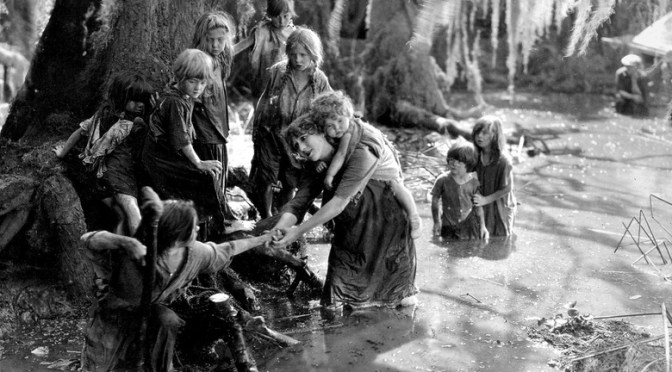
Although William Beaudine received critical acclaim both inside and outside the film industry for his direction, star Mary Pickford felt that he was too cavalier about the safety of the actors, especially in a scene where she had to carry a baby across some water filled with alligators. Pickford wanted to use a doll, but Beaudine insisted on using a real baby, since the alligators’ jaws were bound shut. However, Hal Mohr, the film’s director of photography., debunked this story, saying “There wasn’t an alligator within ten miles of Miss Pickford,” and revealing in precise detail how the effect was done.[3] Regardless, Pickford swore that Beaudine would never work for her or her company as long as she lived. She was as good as her word, as Beaudine never worked for her or United Artists again. Toward the end of the picture, they clashed so often that Beaudine developed a serious paralysis of his face from the pressure and aggravation. He finally turned the picture over to his assistant, Tom McNamara, and left the set. McNamara finished the picture uncredited.

Art director Harry Oliver transformed 3 acres (12,000 m2) of the back lot between Willoughby Avenue and Alta Vista Street into a stylized Gothic swamp. The ground was scraped bare in places, 600 trees were carted in, and pits dug and filled with a mixture of burned cork, sawdust and muddy water.

Filming began in July, over summer vacation. The children had the run of the set, barefoot and in costume, so they would become accustomed to the environment. Each child had a crew member assigned to fish them out of the gunk. These assistants also made sure the kids were cleaned up and comfortable with warm towels when they emerged from the swampy water.

Pickford developed a great fondness for two-year-old Mary Louise Miller. Pickford, who had no children of her own, even tried to adopt the toddler, but her parents refused.

An earlier version of the “Jesus in the barn” scene was filmed in which the dead baby’s spirit was carried to Heaven by a phosphorescent angel. The scene was rejected in favor of the Jesus take.

Sparrows 12

Critical reception

  • The New York Times: “Gustav von Seyffertitz, with a suspicion of Lon Chaney’s penchant for deformity, is emphatically capable as Mr. Grimes. Little as she does, Charlotte Minneau gives an excellent portrait of the cruel and unimaginative Mrs. Grimes. … Although Miss Pickford’s performance is as flawless as ever, it is doubtful whether she served herself well in selecting this special screen story, in which there is an abundance of exaggerated suspense and a number of puerile ideas. It is an obvious heartstring tugger during most of its length, and it frequently dallies with the thrills of old fashioned melodramas.”
  • Motion Picture Magazine, December 1925: “It was Douglas Fairbanks who told us that Mary Pickford’s production of “Sparrows” was Dickensonian. And after seeing it we have nothing less and nothing more to say of it. Perhaps you know that it is the story of a baby farm . . . with Gustav von Seyffertitz as Grimes, the cruel manager . . . and Mary, as Mollie, who watches over the little boys and girls. Melodrama is interwoven in the story and there is nothing new or startling about the plot. But you won’t realize this until the last lovely close-up of Mary has faded from the screen. Which means, of course, that the story interests you so much that your critical faculty is dulled. We are glad that Mary is not going to continue to play grown-ups parts. So many on the screen can be the grand lady. And no one else that we have ever heard about or seen captures the elusive and misty quality of childhood as Mary does. You’ll weep a little. You’ll laugh a great deal. And you’ll hold your breath once or twice.”

Sparrows 4

  • Picture Play, January, 1927: “The choice of “Sparrows” was a singular one for Mary Pickford to make, but no one can deny that she has done the picture surpassingly well. The subject is gloomy, and some of the horrors recall Dickens, yet the darkness is shot through with many laughs. Indeed, so heavily does the hand of melodrama smite “Sparrows” that the picture passes beyond the bounds of credibility. Thus the spectator relaxes, content to give way to his amazement at Mary’s skill. She is Mama Mollie, a lovely waif in whom the maternal instinct is well, there aren’t words to tell how strong it is, for she mothers eleven woebegone, poverty-stricken children at a baby farm kept by the villainous Grimes in the midst of a Louisiana swamp. A kidnapped baby is thrust by Grimes into the group and the plot gets underway, Mollie’s heroic efforts to keep the baby against the will of Grimes leading her and the entire brood into the deadly swamp. “Sparrows” is well worth seeing.”
  • Film historian Jeffrey Vance considers Sparrows to be Pickford’s masterpiece. In his program notes for the Giorante del Cinema Muto (also knows as the Pordenone Silent Film Festival,) Vance writes in 2008: “Sparrows is her most fully realized and timeless work of art. The film’s superb performances, gothic production design, and cinematography all serve a suspenseful, emotionally compelling story anchored by a central performance by Pickford herself imbued with pathos, humor, and charm.”[4]

Accolades

Home Video

Milestone Film & Video released the Library of Congress restoration of Sparrows to DVD and Blu-ray in 2012 as part of a box set called Rags and Riches: Mary Pickford Collection. The home video version contains an audio commentary track by film historians Jeffrey Vance and Tony Maietta.[7]

Sparrows 18

References

Notes

  1. Jump up^ Wood, Bret “Sparrows (1926)” (article) TCM.com
  2. Jump up^ Mankiewicz, Ben. Intro to Turner Classic Movies presentation ofSparrows (May 5, 2010)
  3. ^ Jump up to:a b Landazuri, Margarita. “Sparrows (1926)” (article) TCM.com
  4. Jump up^ Vance, Jeffrey. “Sparrows” Le Giornate del Cinema Muto/27th Pordenone Silent Film Festival program book, October 4, 2008 http://www.cinetecadelfriuli.org/gcm/ed_precedenti/edizione2008/Catalogo2008.pdf
  5. Jump up^ “AFI’s 100 Years…100 Heroes & Villains Nominees” (PDF). Retrieved 2016-08-14.
  6. Jump up^ “AFI’s 100 Years…100 Cheers Nominees” (PDF). Retrieved 2016-08-14.
  7. Jump up^ http://milestonefilms.com/collections/hollywood-classics/products/sparrows

Sparrows 14

Pride of the Clan, The (1917)


Mary Pickford Season: FD Cinematheque

Pride of the Clan, The (1917)

Dir: Maurice Tourneur

Cast: Mary Pickford, Matt Moore, Warren Cook, Kathryn Browne-Decker, Edward Roseman, Joel Day, Leatrice Joy

86 min


The Pride of the Clan is a 1917 American silent romantic drama film directed by Maurice Tourneur, and starring Mary Pickford and Matt Moore.[1]

The film was shot in Fort Lee, New Jersey when many early film studios in America’s first motion picture industry were based there at the beginning of the 20th century

CastEdit

Poor Little Peppina (1916)


Mary Pickford 1

Mary Pickford Season: FD Cinematheque

Poor Little Peppina (1916)

Dir: Sidney Olcott

Cast: Mary Pickford, Eugene O’Brien, Antonio Maiori, Ernest Torti, Edwin Mordant, Jack Pickford, Edith Shayne, Cesare Gravina

48 min

Poor Little Peppina is a 1916 American silent film directed by Sidney Olcott. The film was in 1916 Mary Pickford‘s longest film to be made. It was soon surpassed by her later films.[1]

497full-poor-little-peppina-screenshot

Plot

Robert Torrens (Edwin Mordant) is a wealthy American, residing in Italy with his wife (Edith Shayne) and only daughter, Lois (Eileen Stewart).[2] Franzoli Soldo (Antonio Maiori) is a mafia chief who pretends to be a butler and is in Torrens’ employ. One day, he drinks too freely of his masters’ wine. Fellow employee Pietro (Ernest Torti) informs Mr. Torrens, who next discharges Soldo.

Soldo wants revenge and kills Pietro. He is caught, however, and is being put on trial for the murder. He is found guilty and sentenced to a life in jail. One month later, a mafia member helps him escape. He is determined to take revenge on the Torrens family and kidnaps Lois. When the parents find out, they call the police. Soldo is soon thought of to be the kidnapper, but he ordered some of Torrens’ staff member to convince the parents Lois drowned in an accident.

poor-little-peppina-avi_snapshot_05-04_2012-12-20_19-48-58

Meanwhile, Soldo flees to his relatives, including his wife Bianca (Mrs. A. Maiori) – who is ordered to raise Lois as her own – and his son Beppo (Jack Pickford). Lois grows up to be Peppina (Mary Pickford), Beppo’s sister. Soldo decided to meanwhile take refuge in America. Fifteen years later. The Duchess, an American heiress, takes an interest in Peppina and teaches her English.

A man named Bernando wants to marry Peppina and convinces her parents to let him take her hand. Peppina, however, has no desire to be with him and asks the Duchess what to do. She helps her escape overseas and promises her a friend of hers will provide her a home in America. Peppina runs away from home in disguise and dresses up as a boy so nobody will recognize her.

Hugh Carroll (Eugene O’Brien) is on the boat as well and meets Amy, a socialite from New York. Peppina takes refuge in his cabin, but is soon caught by him. He provides her comfort and food and offers her to stay at his cabin for the night. However, he doesn’t know Peppina is actually a girl.

mw-288-l

In New York, Soldo finds out the Torrens family will move to New York as well. He thinks he will be rewarded if he brings their daughter back to him and is determined to make some money. He sends his relatives in Italy a letter they should bring Peppina to him. Bianca responds she doesn’t know where Peppina is. Meanwhile, Peppina spots Hugh together with Amy and decides to leave him. In New York, she applies for a job in Soldo’s café.

After a bad experience with Soldo, Peppina becomes a messenger “boy”. When she is taken under arrest, she confesses she is actually a girl. Hugh happens to be a chief at the police station and releases Peppina and orders for Soldo to be taken under arrest. After Soldo arrives at the police station, Peppina realizes he was the one who abducted her as a child. Peppina is now recognized as the Torrens’ kid. Mr. and Mrs. Torrens are soon informed and reunited with their child.

Three years have passed. Peppina, now living in wealth, and Hugh are in love with each other.

fcf606f8779ffa4816aa842afb617ef7

Cast

See also

References

  1. Jump up^ The New York Times Review
  2. Jump up^ Eileen Stewart is credited 20 seconds into the film


sjff_03_img1278

Pollyanna (1920)


Mary Pickford 1

Mary Pickford Season: FD Cinematheque

Pollyanna (1920)

Dir: Paul Powell

Cast: Mary Pickford, Wharton James, Katherine Griffith, Helen Jerome Eddy, George Berrell, Howard Ralston, William Courtleigh 

58 min

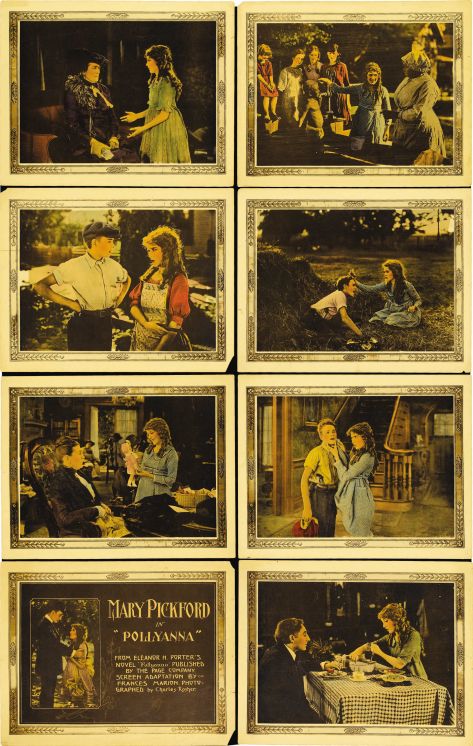
Pollyanna_1920_lobby_card_set

800px-Pollyanna_(1920)_-_10

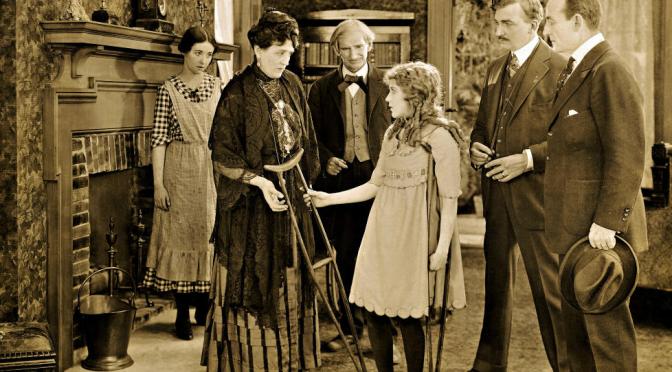
Pollyanna is a 1920 American silent melodrama/comedy film starring Mary Pickford, directed by Paul Powell, and based upon Eleanor H. Porter‘s 1913 novel of the same name. It was Pickford’s first motion picture for United Artists. It became a major success and would be regarded as one of Pickford’s most defining pictures. The film grossed $1.1 million (approximately $13,151,000 today).[2]

Plot

The film opens in the Ozarks where a distraught Pollyanna (Mary Pickford) is comforting her father the Reverend John Whittier (Wharton James) as he dies. After his death Pollyanna is sent to live on a New England plantation with her Victorian Aunt Polly (Katherine Griffith).

Aunt Polly is cold and uncaring to Pollyanna: not picking her up at the station, giving her a sparse room in the attic, and scolding at her every chance she gets. As the days pass Pollyanna’s antics amuse the servants, but not Aunt Polly.

One day while playing on the plantation, Pollyanna gets in trouble with a servant woman and runs to hide in a haystack. There she meets Jimmy Bean (Howard Ralston), an orphan her age. Taking pity on him, Pollyanna is certain eventually Aunt Polly will let him live with them. So she hides him in the cellar. One day Aunt Polly insists in going in the cellar despite Pollyanna’s pleas for fear Jimmy will be discovered. Jimmy is asleep and Pollyanna believes they’re in the clear; until Jimmy starts shouting in his sleep, having a bad dream about turnips chasing and trying to eat him. Pollyanna is amused but Aunt Polly is not. After some pleading, Aunt Polly relents and tells Pollyanna to bring some good quilts for Jimmy.

Screen_Acting_1921_page_55_Mary_Pickford

One day, as Jimmy and Pollyanna play with the other children, they decide to try and steal some apples from a tree belonging to John Pendleton (William Cortleigh). John catches Pollyanna in the act, but forgives her, realizing she is the exact image of her mother, a woman he once loved deeply, but who left him to marry the man who eventually became Pollyanna’s father. He tells Pollyanna this as he shows her a painting of her mother. Meanwhile Jimmy fights his way in, fearing that Pollyanna is in danger. He tries to defend her but finds that everything is normal.

As Pollyanna settles in she seems to bring optimism to those she meets. She is insistent on playing a game her father taught her called ‘The Glad Game’, where one counts the things they are glad for. She visits an old shut-in who is supposedly grateful for nothing. Pollyanna brings along an old blind and deaf friend who plays the accordion. Upon discovering the woman is blind and deaf, the shut-in proclaims her gratitude for still having her sight and hearing.

One day after a fight with Jimmy in which he ‘wishes she would die’, Pollyanna heads into town. She notices a little girl playing in the middle of the road, oblivious to a car coming. Pollyanna leaps in front of the car, throwing the girl to safety, but in the process is hit herself. Jimmy and John both take her back to her Aunt’s place. Aunt Polly becomes frantic and places her in her own lavish bedroom. Realizing the error of her ways, Aunt Polly declares how attached to Pollyanna she is; even giving her a kiss on the forehead, much to Pollyanna’s delight.

LEAD Technologies Inc. V1.01

Realizing they could have lost the little girl forever, many succumb to her wishes for them to be happy. John promises to adopt Jimmy the next day. Aunt Polly refuses to call Dr. Tom, (Herbert Prior), who broke her heart years before. Pollyanna pleads to send for him but she refuses, bringing in another doctor. After several days, they discover Pollyanna is paralyzed from the waist down. Pollyanna becomes distraught; however Jimmy comforts her, insisting she play the Glad Game.

Months pass and Pollyanna begins to use a wheelchair. One evening with Aunt Polly, she pleads one last time for her to send for Dr. Tom and Aunt Polly finally relents. With the help of Dr. Tom, Pollyanna is eventually able to walk again.

With the success of her walking comes the realization of her wishes. Aunt Polly reunites romantically with Dr. Tom; and Jimmy is happily living with John. One day she asks for Jimmy and he comes to wheel her around the garden. He gives Pollyanna a ring and promptly runs off out of fear, not realizing Pollyanna is able to walk. She is excited at the ring and happily runs after him.

MV5BOWE4MjA0YzAtMDBlYi00MjU3LTkwMjUtYzAzMDhkOGVjZThiXkEyXkFqcGdeQXVyNDY1NzU5NjY@._V1_

Cast

Reception

Pollyanna was shot in and has a copyright year of 1919 but was first released in 1920. It had a budget of $300,000 and grossed $1,1 million worldwide on its first theatrical run.[3][4] It was extremely popular, becoming the role that defined Pickford’s ‘little girl’ movies.[5] Pickford was 27 years old at the time of filming and portrayed a 12-year-old.[6]
The film is recognized by American Film Institute in these lists:

Status

A complete print of Pollyanna is preserved at the Mary Pickford Institute for Film Education (The Pickford Corporation also owns the copyright).[8]

995px-Pollyanna_(1920)_-_8

Home media

Pollyanna was initially released on VHS in 1996. In 2007, it was released on DVD as part of a silent films collection titled The Golden Age of Silent Films, and later as part of the Mary Pickford Signature Collection in 2008. In 2010, Nostalgia Family Video also released the film on DVD.[9]

On January 28, 2014, the film was also released on Region 0 DVD-R by Alpha Video.[10]

References

  1. Jump up^ Balio, Tino (2009). United Artists: The Company Built by the Stars. University of Wisconsin Press. ISBN 978-0-299-23004-3.p39
  2. Jump up^ American Experience | Mary Pickford | People & Events | PBS
  3. Jump up^ Balio, Tino (2009). United Artists, Volume 1, 1919–1950: The Company Built by the Stars. 1. Univ of Wisconsin Press. p. 39. ISBN 0-299-23003-1.
  4. Jump up^ Fischer, Lucy, ed. (2009). American Cinema of the 1920s: Themes and Variations. Rutgers University Press. p. 38. ISBN 0-813-54485-8.
  5. Jump up^ Forster, Merna (2004). 100 Canadian Heroines: Famous and Forgotten Faces. Dundurn Press. p. 206. ISBN 1-459-71431-8.
  6. Jump up^ Kroon, Richard W. (2014). A/V A to Z: An Encyclopedic Dictionary of Media, Entertainment and Other Audiovisual Terms. McFarland. p. 500. ISBN 0-786-45740-6.
  7. Jump up^ “AFI’s 100 Years…100 Cheers Nominees” (PDF). Retrieved 2016-08-14.
  8. Jump up^ “Pollyanna”. silentera.com. Retrieved January 6, 2015.
  9. Jump up^ “Pollyanna (1920)”. silentera.com. Retrieved January 6, 2015.
  10. Jump up^ “Alpha Video – Pollyanna”. Retrieved January 30, 2014.

Moore-Pollyanna001

Cinderella (1914)


Mary Pickford 1

Mary Pickford Season: FD Cinematheque

Cinderella (1914)

Dir: James Kirkwood

Cast: Mary Pickford, Owen Moore, Isabel Vernon, Georgia Wilson, Lucille Carney, W N Cone, Inez Ranous, Hayward Mack

52 min


Cinderella is a 1914 silent film starring Mary Pickford, directed by James Kirkwood, Sr., produced by Daniel Frohman, and released by Famous Players Film Company. The film is based upon the fairy tale Cinderella. The film was released on Blu-ray & DVD as a bonus feature from the DVD of Through the Back Door (1921).[1]

Contents

PlotEdit

Cinderella is a kind young woman who lives with her wicked stepmother and ugly stepsisters plus her evil father. They abuse her and use her as the house maid. Cinderella thinks she’s all alone in the world, but doesn’t know a fairy godmother is constantly helping her. One day, she is collecting wood from the forest and meets Prince Charming. They immediately fall in love with each other, but lose contact. Soon, a ball is arranged by the prince to look for his future wife. The stepsisters think they make a great chance in being chosen by the prince. Cinderella wants to go as well, but isn’t allowed to by her cruel family.

The sisters go to a fortune teller, who announces a member of the family will be chosen by the prince. The sisters are delighted and think it will be one of the two of them. When they leave for the ball, Cinderella is left behind. The fairy godmother appears and asks if she wants to go to the ball as well. When Cinderella responds positively, the fairy godmother orders her to bring her the biggest pumpkin she can find. Cinderella does so and the fairy godmother changes it into a luxurious stage coach. She next asks for the smallest mice she can find. Cinderella brings her some mice from the house and the fairy godmother changes them into horses.

The fairy godmother next orders her to bring her the biggest rats there are. After Cinderella collected them, the fairy godmother changes them into servants. She finally changes Cinderella’s poor maiden costume into a dress fit for a princess, and glass slippers, of course. She reminds Cinderella she will have to be back at home before the clock strikes midnight. Otherwise, her fine dress will turn into rags and the coach and servants will become what they were before.

As Cinderella arrives at the party, Prince Charming is already busy looking for his future wife. It is soon announced an unknown lady has arrived in a coach. Prince Charming immediately chooses her and they go to a private place where they learn to know each other. As they flirt, Cinderella notices it is almost twelve o’clock and storms out. She loses her glass slipper, before she turns into her old poor self again.

The next day, the royal heralds announce the Prince’s wish to marry the woman whose foot fits the lost glass slipper. The sisters go to the palace to try fit their feet into the slippers, while Cinderella is yet again forced to stay home. It becomes clear the royal heralds every woman of the town has tried but failed to wear the slippers, except for Cinderella. Prince Charming immediately goes to visit her and is shocked when he finds out she is a poor maid. He doesn’t turn his back against her, though, and he invites her to try on the slipper. When she does, she is announced as the future princess. The royal heralds give her the opportunity to behead her sisters, but she refuses to.

In the final scene, the fairy godmother appears and blesses her. Cinderella and Prince Charming live happily ever after.

CastEdi


tumblr_li5vixnako1qdwkdyo1_500

Tess of the Storm Country (1922)


Mary Pickford 1

Mary Pickford Season: FD Cinematheque

Tess of the Storm Country (1922)

Dir: John S Robertson

Cast: Mary Pickford, Lloyd Hughes, Gloria Hope, David Torrence, Forrest Robinson, Jean Hersholt, Danny Hoy, Robert Russell, Gus Saville, Milton Berle


Tess of the Storm Country is a 1922 melodrama starring Mary Pickford, directed by John S. Robertson, and based upon a Grace Miller White novel. It is a remake of Pickford’s film from eight years prior and was subsequently remade a decade later as asound version starring Janet Gaynor.

Contents

ProductionEdit

Leading actress Pickford’s previous film Little Lord Fauntleroy flopped critically. Pickford realized she had to make a movie the audience loved to see her in.[1] She wanted to play the role again, because she loved the character and stated the crew had more abilities with a bigger budget and better technology.[2]

PlotEdit

17-year-old Tess Skinner is the daughter of a squatter, and wealthy man Elias Graves, who owns the land, is trying to get rid of them and the other squatter families. Tess is just as determined to make sure they all stay. Elias, however, grows more stubborn with failure. His determination to disperse the squatters has become an obsession. He is determined to kick them out of his land, not caring they don’t have another place to go to. Graves’ son, Frederick, is on her side and doesn’t think about squatters the way his father does. Frederick’s sister Teola fears her father, who thinks obedience is more important than love. She has fallen in love with law student Dan Jordan, but he hasn’t been able to impress Elias.

Dan tries to win over Teola’s father’s trust in him by suggesting he can throw the squatters off his land, because they are catching fish illegally. Frederick, meanwhile, is charmed by Tess and admits he could really fall for her if she would get cleaned up. When men come to the Skinner residence to find proof they’re netting, Tess hides the evidence her father is a fisherman. Later, they become hungry and Tess’ father decides to start fishing again. He is caught and when Dan Jordan is shot to death, Tess’ dad is blamed for it and taken under arrest. Tess is crushed and takes it out on Elias when he announces he will do anything for her dad to pay the penalty. When the trial starts, Tess is crushed she isn’t allowed to visit her father. The evil Ben Letts forces himself up to her as her future husband, despite the fact Tess is unwilling to marry him. She chases him away, but Ben vows vengeance.

Now that Tess is all alone, Frederick keeps her company and they fall in love. Elias finds out and tells Fred he doesn’t want to have anything to do with him anymore. Frederick announces he is planning on marrying Tess as soon as he finishes college. Meanwhile, Teola finds out she is pregnant and already started planning to marry Dan, but now that he’s dead, the child will be born out of wedlock. She plans on killing herself, but doesn’t have the nerve to. Tess protects her by claiming the child as her own. After the baby is born, Teola keeps on supporting her financially. One night, Teola isn’t allowed to leave the house, so Tess breaks in to get milk for the baby. She is caught by Elias, who is outraged. Meanwhile, Fred has just returned from college. Ben’s mate threatens him to tell the truth about Ben having killed Dan Jordan. Ben becomes mad and strangles him. He next hides the body.

Fred pays Tess a visit and finds his sister there as well. When he notices the baby, Tess tells him she found it. Fred doesn’t believe her and thinks the baby is hers. He is shocked and ashamed and leaves immediately. Meanwhile, Ben fears of getting caught and plans on leaving town. He is determined to take Tess with him. He sneaks into her cottage and notices the baby. When Tess comes in, he forces her to marry him. She refuses to, but Fred comes in to rescue her. They together hit Ben unconscious, but Fred leaves bitterly as he is still shocked about Tess having a baby. Ben’s strangled mate meanwhile survived and announces Ben Letts is responsible for the killing of Dan.

Tess is ostracized and the dying infant is refused baptism, so Tess sneaks into the church and does her own ritual. Teola and Elias are both in presence. Elias demands for her to be thrown out of church, but Teola becomes too emotional and admits the baby is hers. Elias is shocked but forgives her, but Teola soon dies. Fred realizes he has made an awful mistake, but Tess isn’t able to forgive his horrible treatment towards her. She goes back home and reunites with her father, who has just been released from jail. Elias and Fred later stop by to apologize. Both Elias and Fred are forgiven and the film ends with Tess and Fred kissing.

CastEdit


e807f8c9865db47683974051eb48d9bc
Pickford in “Tess of the Storm Country” (1922). Photo coutesy of Academy of Motion Picture Arts and Sciences

Tess of the Storm Country (1914)


Mary Pickford 1

Mary Pickford Season: FD Cinematheque

Tess of the Storm Country (1914)


Dir: Edwin S Porter

Cast: Mary Pickford, Harold Lockwood, Olive Carey, David Hartford, Louise Dunlap, William Walters, Richard Garrick, Eugene Walter, Jack Henry

 80 min


Tess of the Storm Country is a 1914 silent drama, based on the 1909 novelof the same name by Grace Miller White. It starred Mary Pickford, in a role she would reprise eight years later for the 1922 adaptation by John S. Robertson.[1][2]

In 2006, the film was named to the National Film Registry by the Librarian of Congress, for its “cultural, aesthetic, or historical significance”.[3]

CastEdit

Stella Maris (1918)


Mary Pickford 1

Mary Pickford Season: FD Cinematheque

Stella Maris (1918)


Dir: Marshall Neilan

Cast: Mary Pickford, Ida Waterman, Herbert Standing, Conway Tearle, Marcia Manon, Josephine Crowell, Lou Conley, Gustav Von Seyffertitz

84 min


Stella Maris is a 1918 American silent drama film directed by Marshall Neilan, written by Frances Marion and based on William John Locke‘s 1913 novel of the same name. The film stars Mary Pickford in dual roles as the title character and an orphan servant.

The film was remade in 1925, with Mary Philbin in the title role.

Plot

Stella Maris (Mary Pickford) was born paralyzed and is unable to walk. Her wealthy guardians try to prevent her from being exposed to all the bad that is happening in the world. She is not allowed to leave her room in a London mansion and is bound to her bed. Her door even has a sign on it which says: “All unhappiness and world wisdom leave outside. Those without smiles need not enter.” [1] Stella has no idea a war is going on in the world and that there are poor and hungry people.

John Risca (Conway Tearle) is a well-known journalist and a friend of the family. He has been unhappily married to Louise for six years now and frequently visits Stella. John wants Stella to think he is perfect and lies about being unmarried. Louise, meanwhile, wants a servant in her house and hires orphan Unity Blake (also Mary Pickford). Unity is uneducated and has been deprived and mistreated for her entire life. This resulted in her being afraid of everyone.

One night, a drunk Louise orders Unity to get some groceries. Unity does what she is told and on her way back, the food is stolen by kids. She returns to the home only to be beaten by an outraged Louise. Unity is severely hurt and Louise gets arrested. It is announced she will have to serve three years in prison. John is kinder to Unity and adopts her. Unity is very grateful and falls in love with him. John himself is only interested in Stella. John wishes Unity to be raised at the Blount’s residence, but they don’t want her. They prevent her from meeting Stella, fearing Stella will notice there are suffering people in the world. They finally convince John to raise Unity at Aunt Gladys’ house.

In order to make John fall in love with her, Unity starts to educate herself. Meanwhile, Stella gets an operation and is able to walk after three years. She meets John and they fall in love. One day she decides to give John a surprise visit. Louise, who has just been released from jail, opens the door and tells Stella the truth about her marriage. Stella is heartbroken upon learning that he lied to her about his marriage. Feeling betrayed, she tells John to leave her alone and refuses to talk to her family upon seeing how much sadness and pain are in the world.

Meanwhile, Unity uses one of John’s suits and pretends he is asking her to marry him. When he comes home heartbroken over losing Stella, she tries to busy herself with work. As she hears Aunt Gladys’ concerns about John’s inability to be free to love Stella while Louise lives, Unity realizes she and John can never be a couple. At her relatives’ home, Stella reconciles with them and comes to the realization that while there will be sadness and pain in the world, there are also joy and happiness that follows it. At Aunt Gladys’ home, Unity writes him a note which she thanks him for showing her kindness and says he should get together with Stella. She secretly grabs a gun from a gun collection and settles the score by killing Louise for the pain she inflicted on herself, Stella and John. She next kills herself, making the police think it was a revenge murder as her troubled history is well known even to them. Aunt Gladys convinces Stella’s wealthy relatives to give John another chance and not think badly about Unity for she helped free him from his abusive wife. John is reunited with Stella and they marry.

Cast

Reception

Like many American films of the time, Stella Maris was subject to cuts by city and state film censorship boards. For example, the Chicago Board of Censors required a cut of the shooting by Unity.[2]

Preservation status

Stella Maris still exists with copies preserved at the Mary Pickford Institute for Film Education and the Library of Congress.[3]

DVD release

Stella Maris was released on Region 0 DVD by Milestone Film & Video on April 18, 2000.[4]

Stella Maris 15

Rebecca of Sunnybrook Farm (1917)


Mary Pickford 1

Mary Pickford Season: FD Cinematheque

Rebecca of Sunnybrook Farm (1917)

Dir: Marshall Neilan

Cast: Mary Pickford, Eugene O’Brien, Helen Jerome Eddy, Charles Ogle, Marjorie Daw, Mayme Kelso, Jane Wolfe, Josephine Crowell

78 min

Rebecca of Sunnybrook Farm is a 1917 American silent comedy-drama film directed by Marshall Neilan based upon the novel of the same name by Kate Douglas Wiggin. This version is notable for having been adapted by famed female screenwriter Frances Marion. The film was made by the “Mary Pickford Company” and was an acclaimed box office hit. When the play premiered on Broadway in the 1910 theater season the part of Rebecca was played by Edith Taliaferro.[1][2][3]

Plot

As described in a film magazine,[4] Rebecca Randall (Pickford) is taken into the home of her aunt Hannah (Eddy), a strict New England woman. Rebecca meets Adam Ladd (O’Brien), a young man of the village, and they become great friends. One day Rebecca promises to marry Adam when she becomes of age. Unable to withstand her pranks any longer, her aunt sends her away to a boarding school. She graduates a beautiful young lady. Shortly thereafter, Adam demands a fulfillment of her promise.

Cast

Production

Rebecca of Sunnybrook Farm was filmed in Pleasanton, California.

Reception

Like many American films of the time, Rebecca of Sunnybrook Farm was subject to cuts by city and state film censorship boards. The Chicago Board of Censors required a cut of the intertitle “I have just learned the Simpsons are not married.”[5]

Rebecca of Sunnybrook Farm 14

Poor Little Rich Girl, The (1917)


Mary Pickford 1

Mary Pickford Season: FD Cinematheque

Poor Little Rich Girl, The (1917)


Dir: Maurice Tourneur

Cast: Mary Pickford, Madlaine Traverse, Charles Wellesley, Gladys Fairbanks, Frank McGlynn Sr., Emilie La Croix, Marcia Harris, Charles Craig, Frank Andrews

76 min


The Poor Little Rich Girl is a 1917 American comedy-drama film directed by Maurice Tourneur. Adapted by Frances Marion from the 1913 play by Eleanor Gates.[1] The Broadway play actually starred future screen actress Viola Dana.[2] The film stars Mary Pickford, Madlaine Traverse, Charles Wellesley, Gladys Fairbanks (returning from the play) and Frank McGlynn, Sr.

The film was shot in Fort Lee, New Jersey when early film studios in America’s first motion picture industry were based there at the beginning of the 20th century.[3][4][5] In 1991, The Poor Little Rich Girl was deemed “culturally, historically, or aesthetically significant” by the United States Library of Congress and selected for preservation in the National Film Registry.

Plot

Gwendolyn is an 11-year-old girl who is left by her rich and busy parents to the care of unsympathetic domestic workers at the family’s mansion. Her mother is only interested in her social life and her father has a serious financial problem and is even contemplating suicide. When she manages to have some good time with an organ-grinder or a plumber, or have a mud-fight with street boys, she is rapidly brought back on the right track. One day she becomes sick because the maid has given her an extra dose of sleeping medicine to be able to go out. She then becomes delirious and starts seeing an imaginary world inspired by people and things around her; the Garden of Lonely Children in the Tell-Tale forest. Her conditions worsens and Death tries to lure her to eternal rest. But Life also appears to her and finally wins.[6]

Cast

Heart O’The Hills (1919)


Mary Pickford 1

Mary Pickford Season: FD Cinematheque

Heart O’The Hills (1919)


Dir: Joseph De Grasse and Sidney Franklin

Cast: Mary Pickford, Harold Goodwin, Allan Sears, Fred Huntley, Claire McDowell, Sam De Grasse

87 min


Heart O The Hills 1

Heart O The Hills 3


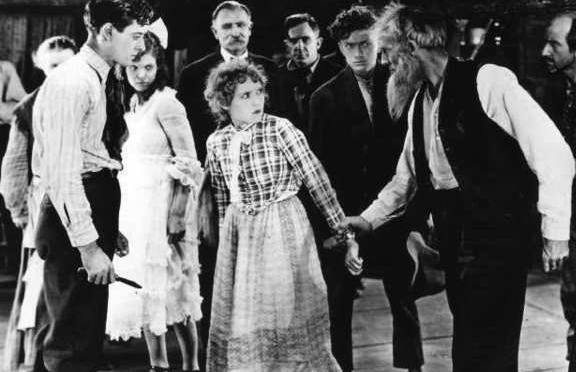
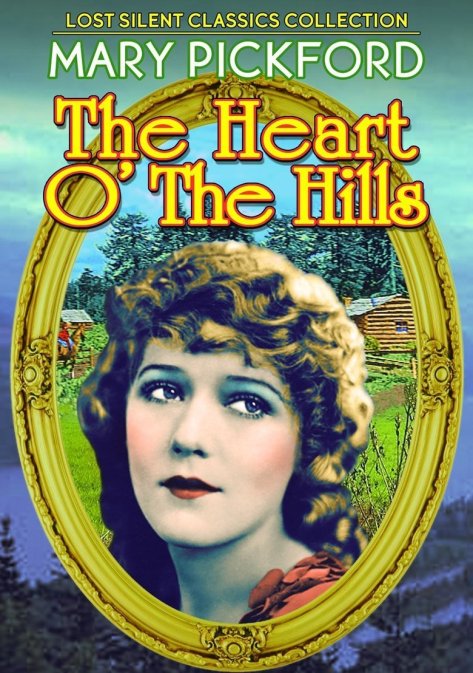
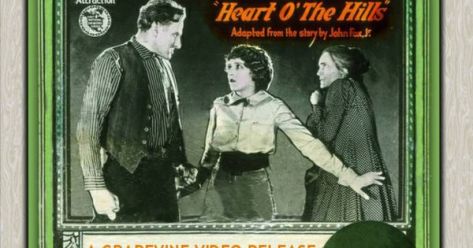
Heart o’ the Hills is a 1919 American silent drama film directed by Joseph De Grasse and Sidney Franklin, written by Bernard McConville based on John Fox, Jr.‘s novel of the same name.

Plot

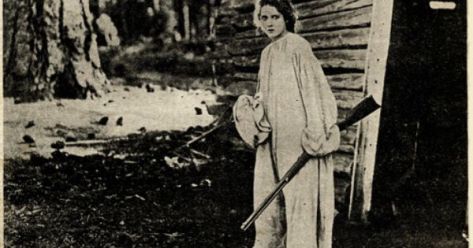
Jason Honeycutt (Harold Goodwin) is a young boy who lives with his stepfather chief Steve Honeycutt (Sam De Grasse) at the ancestral Honeycutts’ home. One day the chief is looking for the 13-year-old mountain girl Mavis Hawn (Mary Pickford), who is shooting bullets in the woods. Mavis desires revenge after a few gang members attacked her home and shot and killed her father. One of her only friends is geologist and school teacher John Burnham (Fred Warren). He suggests she get an education instead of learning to use a gun.

Chief Honeycutt visits Mavis’ widowed mother Martha Hawn (Claire McDowell) and flirts with her. Meanwhile, Mavis is fishing at a pond near her home with Jason. He reveals his stepfather is manipulating Martha into granting him her land. When a group of planters and capitalists come to town intending to exploit mountain coal lands, Mavis scares them away with her gun. She and Jason later run into the rich aristocrat Gray Pendleton (John Gilbert) and his sweetheart Marjorie Lee (Betty Bouton), who are looking for the town.

Back at home, Mavis is disappointed Steve is still there. Later that night, Mavis visits a party and meets Gray for the second time. He flirts with her, which makes Jason jealous. Gray forces himself up to Mavis, which makes her upset and angry. She leaves the party and finds out her mother has left her to marry Steve. She decides to marry as well and proposes to Jason. However, they soon find out they are too young.

When word hits town that a man named Morton Sanders (Henry Hebert) is planning to take over the city, some of the inhabitants, including Mavis, threaten him to force him go away. Later that night, Morton is found dead and the police are looking for everyone who was involved. The police visits the Hawn house, but Mavis’ grandfather (Fred Huntley) forces them to go away. While holding them off with his shotgun, Mavis packs her things and goes to hide in the forest. The next day, John Burnham visits her and convinces her to go to trial to prove her innocence.

In court, the lawyer of the other party demands for her to be hanged. The town folks try to defend her by all admitting they have shot Morton. Mavis is discharged and finally decides to go to school. Mr. Burnham, Gray and Marjorie are all pleased with Mavis’ decision. Jason however, becomes jealous again when she starts hanging out with Gray at school and leaves her.

Six years pass. Mavis has been adopted by the rich Colonel Pendleton (W.H. Bainbridge). One day she receives a letter from her mother, announcing she is getting old and will most likely die soon. She decides to visit her mother and finds out Steve killed her father. He has become violent and takes it out on Martha. Mavis tries to help her and shoots Steve. Martha survives the incident and takes Mavis in to live with her. Mavis is reunited with a grown-up Jason and they marry.

Cast


Heart O The Hills 6

Documentary Film


Documentary film

 Flaherty 2

Nanook of the North (1922)

Prepared by Daniel B Miller
A documentary film is a nonfictionalmotion picture intended to document some aspect of reality, primarily for the purposes of instruction, education, or maintaining a historical record.[1] Such films were originally shot on film stock—the only medium available—but now include video and digital productions that can be either direct-to-video, made into a TV show, or released for screening in cinemas. “Documentary” has been described as a “filmmaking practice, a cinematic tradition, and mode of audience reception” that is continually evolving and is without clear boundaries.[2]

Definition

Matuszewski 1

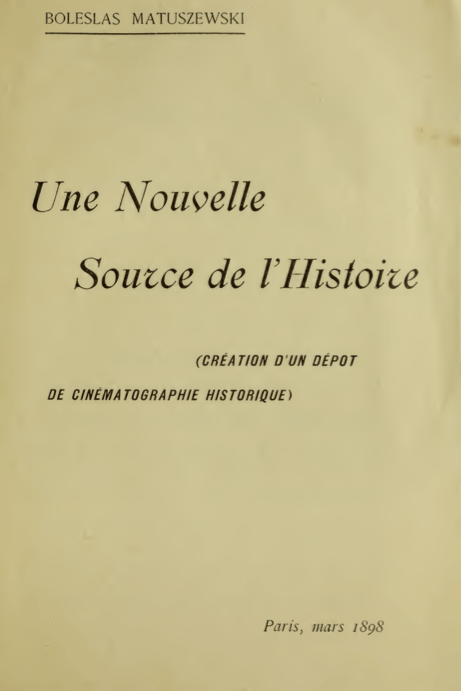
Bolesław Matuszewski book Une nouvelle source de l’histoire 1898 frontispiece
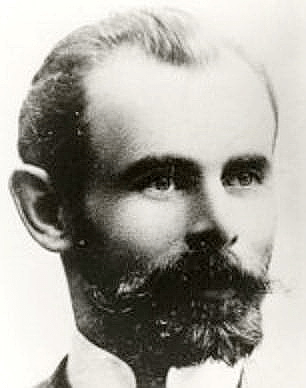
Matuszewski 2

Boleslaw Matuszewski

The cover of Bolesław Matuszewski book Une nouvelle source de l’histoire. (A New Source of History) from 1898 the first publication about documentary function of cinematography.

Polish writer and filmmaker Bolesław Matuszewski was among those who identified the mode of documentary film. He wrote two of the earliest texts on cinema Une nouvelle source de l’histoire (eng. A New Source of History) and La photographie animée (eng. Animated photography). Both were published in 1898 in French and among the early written works to consider the historical and documentary value of the film.[3] Matuszewski is also among the first filmmakers to propose the creation of a Film Archive to collect and keep safe visual materials.[4]
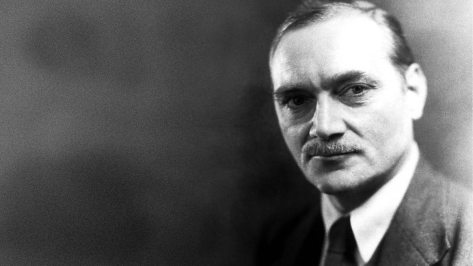
Grierson John 1

John Grierson

Moana 1

Moana (1926)

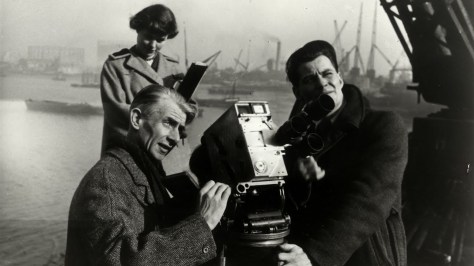
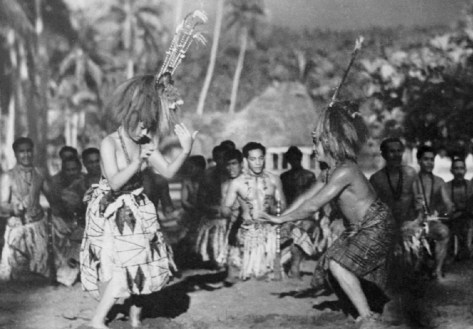
In popular myth, the word documentary was coined by Scottish documentary filmmaker John Grierson in his review of Robert Flaherty‘s film Moana (1926), published in the New York Sun on 8 February 1926, written by “The Moviegoer” (a pen name for Grierson).[5]

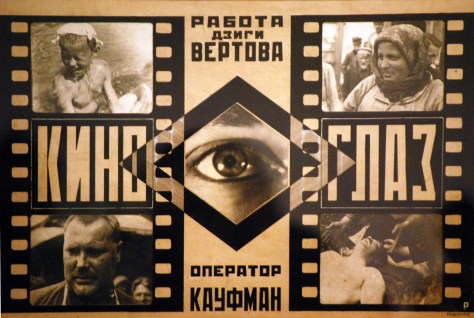
Grierson’s principles of documentary were that cinema’s potential for observing life could be exploited in a new art form; that the “original” actor and “original” scene are better guides than their fiction counterparts to interpreting the modern world; and that materials “thus taken from the raw” can be more real than the acted article. In this regard, Grierson’s definition of documentary as “creative treatment of actuality”[6] has gained some acceptance, with this position at variance with Soviet film-maker Dziga Vertov‘s provocation to present “life as it is” (that is, life filmed surreptitiously) and “life caught unawares” (life provoked or surprised by the camera).
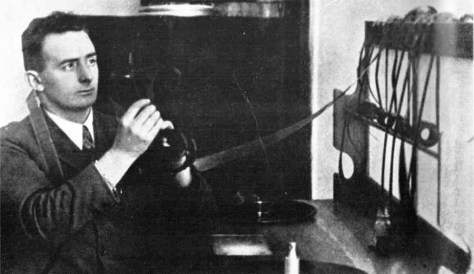
Vertov Dziga 1

Dziga Vertov

Vertov Kino Glas 1

Dziga Vertov – Kino Glaz (1924)

The American film critic Pare Lorentz defines a documentary film as “a factual film which is dramatic.”[7] Others further state that a documentary stands out from the other types of non-fiction films for providing an opinion, and a specific message, along with the facts it presents.[8]

Documentary practice is the complex process of creating documentary projects. It refers to what people do with media devices, content, form, and production strategies in order to address the creative, ethical, and conceptual problems and choices that arise as they make documentaries.

Documentary filmmaking can be used as a form of journalism, advocacy, or personal expression.
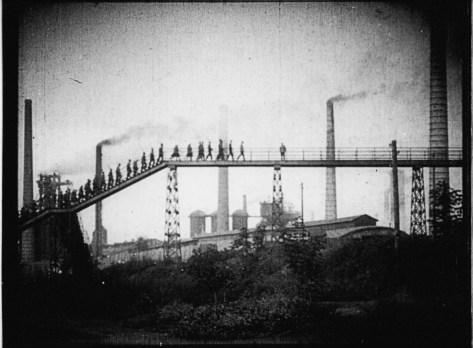
Man With A Movie Camera 1

Man With A Movie Camera (1929)

History
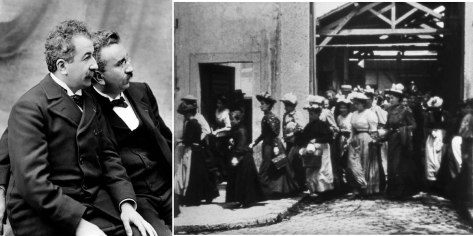
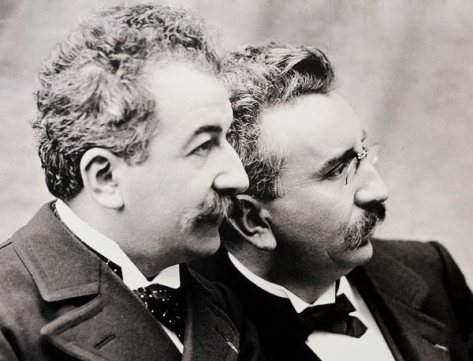
Lumiere Brothers 1Auguste and Louis Lumiere  – Factory Workers Leaving Work (1896)

Pre–1900

Early film (pre-1900) was dominated by the novelty of showing an event. They were single-shot moments captured on film: a train entering a station, a boat docking, or factory workers leaving work. These short films were called “actuality” films; the term “documentary” was not coined until 1926. Many of the first films, such as those made by Auguste and Louis Lumière, were a minute or less in length, due to technological limitations.

Films showing many people (for example, leaving a factory) were often made for commercial reasons: the people being filmed were eager to see, for payment, the film showing them. One notable film clocked in at over an hour and a half, The Corbett-Fitzsimmons Fight. Using pioneering film-looping technology, Enoch J. Rector presented the entirety of a famous 1897 prize-fight on cinema screens across the United States.
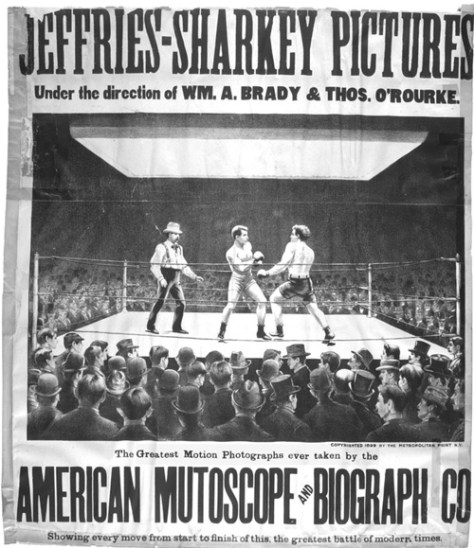
Corbett Fitzimmons Figh 1

The Corbett – Fitzsimmons Fight – Film Poster (1897)
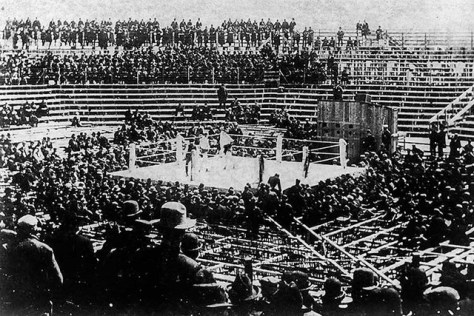
Corbett Fitzimmons Fight 2

The Corbett – Fitzsimmons Fight (1897)

In May 1896, Bolesław Matuszewski recorded on film few surigical operations in Warsaw and Saint Petersburg hospitals. In 1898, French surgeon Eugène-Louis Doyen invited Bolesław Matuszewski and Clément Maurice and proposed them to recorded his surigical operations. They started in Paris a series of surgical films sometime before July 1898.[9] Until 1906, the year of his last film, Doyen recorded more than 60 operations. Doyen said that his first films taught him how to correct professional errors he had been unaware of. For scientific purposes, after 1906, Doyen combined 15 of his films into three compilations, two of which survive, the six-film series Extirpation des tumeurs encapsulées (1906), and the four-film Les Opérations sur la cavité crânienne (1911). These and five other of Doyen’s films survive.[10]
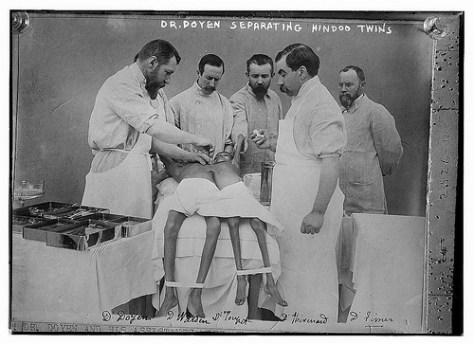
Doyen Eugene Louis 1

Matuszewski/Maurice – Dr Doyen Surgery (1902)

Between July 1898 and 1901, the Romanian professor Gheorghe Marinescu made several science films in his neurology clinic in Bucharest:[11]Walking Troubles of Organic Hemiplegy (1898), The Walking Troubles of Organic Paraplegies (1899), A Case of Hysteric Hemiplegy Healed Through Hypnosis (1899), The Walking Troubles of Progressive Locomotion Ataxy (1900), and Illnesses of the Muscles (1901). All these short films have been preserved. The professor called his works “studies with the help of the cinematograph,” and published the results, along with several consecutive frames, in issues of “La Semaine Médicale” magazine from Paris, between 1899 and 1902.[12]
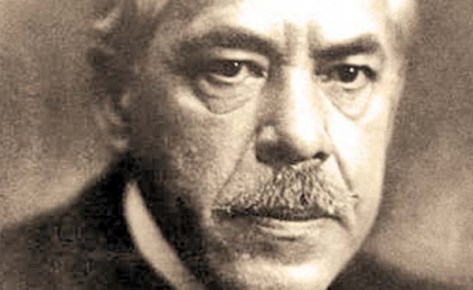
Marinescu Gheorge 1

Gheorghe Marinescu

In 1924, Auguste Lumiere recognized the merits of Marinescu’s science films: “I’ve seen your scientific reports about the usage of the cinematograph in studies of nervous illnesses, when I was still receiving “La Semaine Médicale,” but back then I had other concerns, which left me no spare time to begin biological studies. I must say I forgot those works and I am thankful to you that you reminded them to me. Unfortunately, not many scientists have followed your way.”[13][14][15]

1900–1920
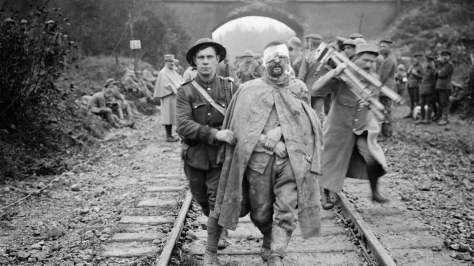
Mallins Geoffrey 1

Geoffrey Malins WW1 Documentaries

Travelogue films were very popular in the early part of the 20th century. They were often referred to by distributors as “scenics.” Scenics were among the most popular sort of films at the time.[16] An important early film to move beyond the concept of the scenic was In the Land of the Head Hunters (1914), which embraced primitivism and exoticism in a staged story presented as truthful re-enactments of the life of Native Americans.

Contemplation is a separate area. Pathé is the best-known global manufacturer of such films of the early 20th century. A vivid example is Moscow clad in snow (1909).
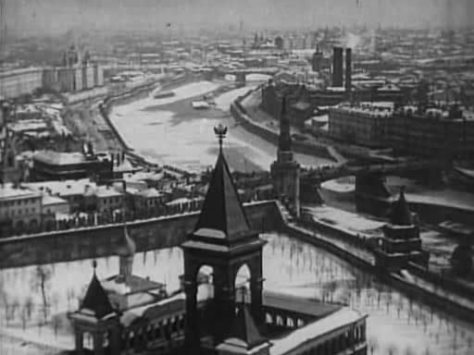
Moscow Clad in Snow 3

Moscow Clad in Snow (1909)

Biographical documentaries appeared during this time, such as the feature Eminescu-Veronica-Creangă (1914) on the relationship between the writers Mihai Eminescu, Veronica Micle and Ion Creangă (all deceased at the time of the production) released by the Bucharest chapter of Pathé.

Early color motion picture processes such as Kinemacolor—known for the feature With Our King and Queen Through India (1912)—and Prizmacolor—known for Everywhere With Prizma (1919) and the five-reel feature Bali the Unknown (1921)—used travelogues to promote the new color processes. In contrast, Technicolor concentrated primarily on getting their process adopted by Hollywood studios for fictional feature films.
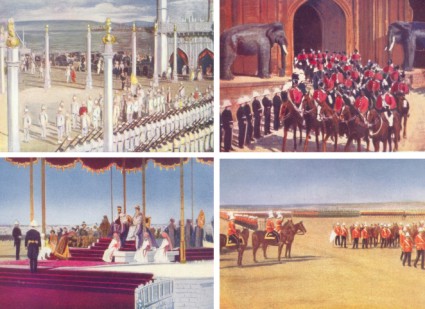
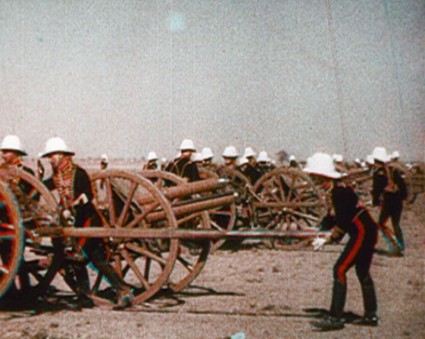
With Our King and Queen Through India 1

With Our King and Queen Through India 2

With Our King and Queen Through India (1912)
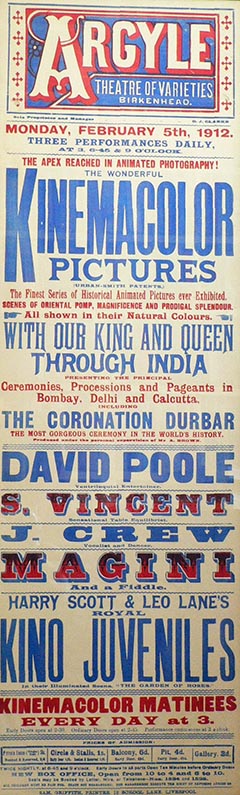
Kynemacolor 1

Kinemacolor Poster (1912)

Also during this period, Frank Hurley‘s feature documentary film, South (1919), about the Imperial Trans-Antarctic Expedition was released. The film documented the failed Antarctic expedition led by Ernest Shackleton in 1914.
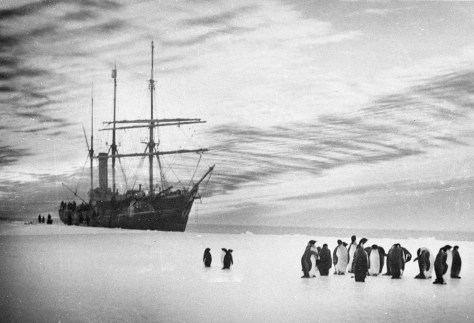
South Frank Hurley 1

Frank Hurley’s South (1914)

1920s

Romanticism
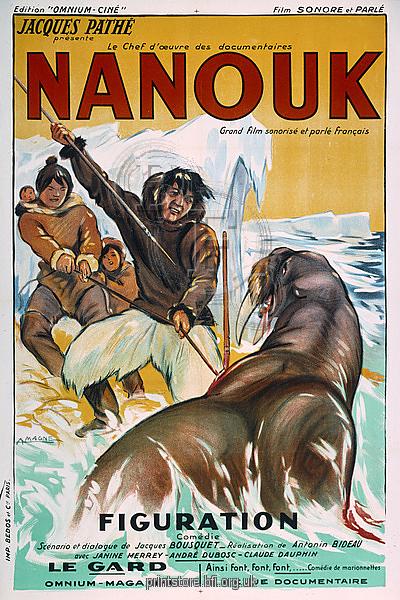
Poster for Robert Flaherty's Nanook of the North (1922)

Nanook of the North (1922)

With Robert J. Flaherty‘s Nanook of the North in 1922, documentary film embraced romanticism; Flaherty filmed a number of heavily staged romantic films during this time period, often showing how his subjects would have lived 100 years earlier and not how they lived right then. For instance, in Nanook of the North, Flaherty did not allow his subjects to shoot a walrus with a nearby shotgun, but had them use a harpoon instead. Some of Flaherty’s staging, such as building a roofless igloo for interior shots, was done to accommodate the filming technology of the time.
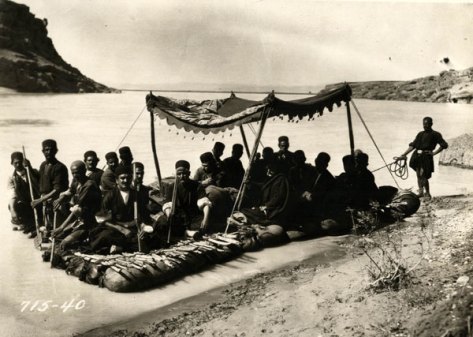
Grass 1

Grass (1925)

Paramount Pictures tried to repeat the success of Flaherty’s Nanook and Moana with two romanticized documentaries, Grass (1925) and Chang (1927), both directed by Merian Cooper and Ernest Schoedsack.
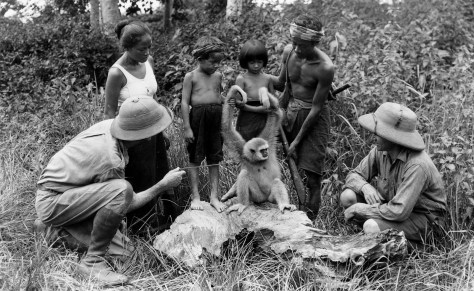
Chang 1

On the set of Chang (1927)

Chang 2

Chang ( 1927)

Chang 3

Chang (1927) Poster

The city symphony

City Symphony Films were avant-garde films made during the 1920s to 1930s. These films were particularly influenced by modern art: namely Cubism, Constructivism, and Impressionism. (See A.L Rees, 2011)[17] According to Scott Macdonald (2010), city symphony film can be located as an intersection between documentary and avant-garde film; “avant-doc”. However, A.L. Rees suggest to see them as avant-garde films. (Rees, 2011: 35)
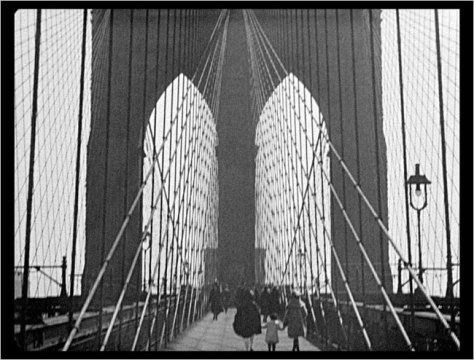
Manhatta 2

Manhatta (1921)

Manhatta 1

Manhatta (1921)

City Symphony films include Manhatta (dir. Paul Strand, 1921), Paris Nothing but the Hours (dir. Alberto Cavalcanti, 1926), Twenty Four Dollar Island (dir. Robert Flaherty, 1927), Études sur Paris (dir. André Sauvage, 1928), The Bridge (1928), and Rain (1929), both by Joris Ivens.
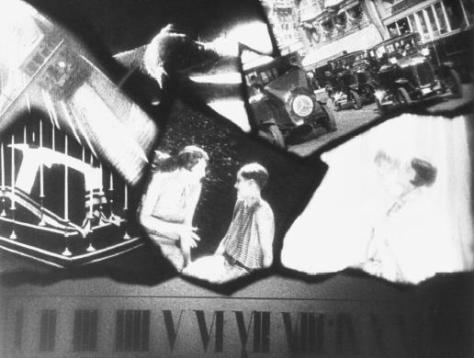
Paris Nothing But Hours 1

Paris Nothing But Hours (1926) – Alberto Cavalcanti
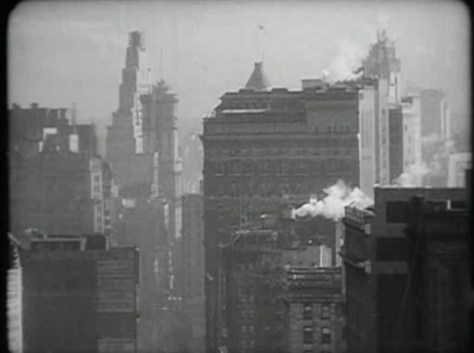
Twenty Four Dollar Island 1

Twenty-Four Dollar Island (1927) – Robert Flaherty
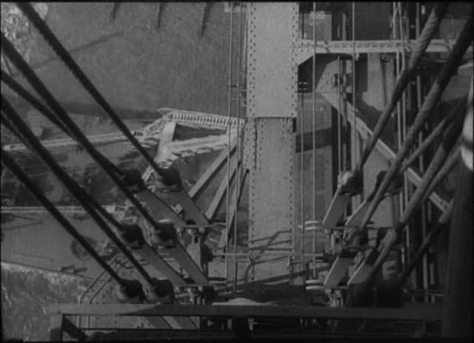
Bridge 1

Bridge (1928) – Joris Ivens

Rain ivens 1

Rain (1929) – Joris Ivens

But the most famous city symphony films are Berlin, Symphony of a Great City (dir. Walter Ruttman, 1927) and The Man with a Movie Camera (dir. Dziga Vertov, 1929).
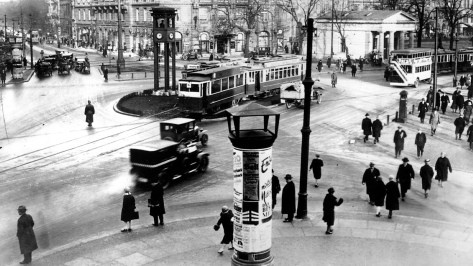
Berlin 2

Berlin, Symphony of a Great City (1927)  – Walter Ruttman
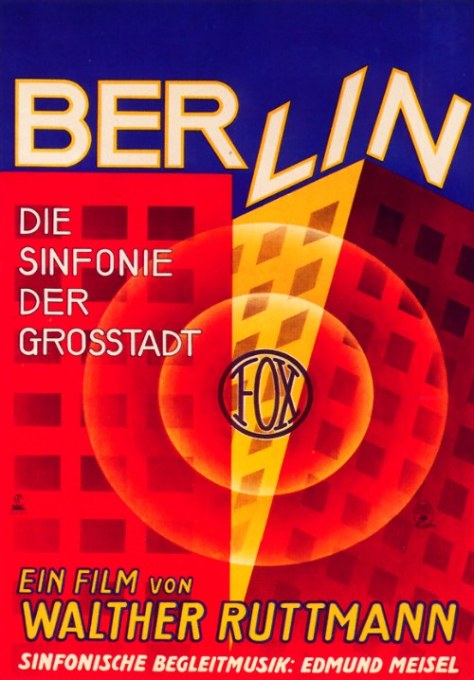
Berlin 1

Berlin, Symphony of a Great City (1927)  – Walter Ruttman – Film Poster

Walter Ruttmann’s Berlin, Symphony of a Great City (1927),  is shot and edited like a visual-poem.

A City Symphony Film, as the name suggests, is usually based around a major metropolitan city area and seek to capture the lives, events and activities of the city.

It can be abstract and cinematographic (see Walter Ruttmann’s Berlin) or utilise Russian Montage theory (See Dziga Vertov’s Man with the Movie Camera). But most importantly, a city symphony film is like a cine-poem and is shot and edited like a “symphony”.
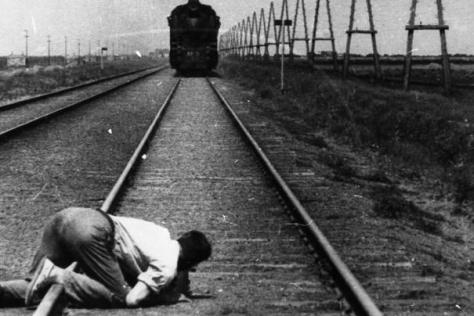
Man With A Movie Camera 2

Man With A Movie Camera (1929)

In Man with a Movie Camera, Mikhail Kaufman acts as a cameraman risking his life in search of the best shot

The continental, or realist, tradition focused on humans within human-made environments, and included the so-called “city symphony” films such as Walter Ruttmann‘s Berlin, Symphony of a City (of which Grierson noted in an article[18] that Berlin represented what a documentary should not be), Alberto Cavalcanti‘s Rien que les heures, and Dziga Vertov‘s Man with the Movie Camera. These films tend to feature people as products of their environment, and lean towards the avant-garde.
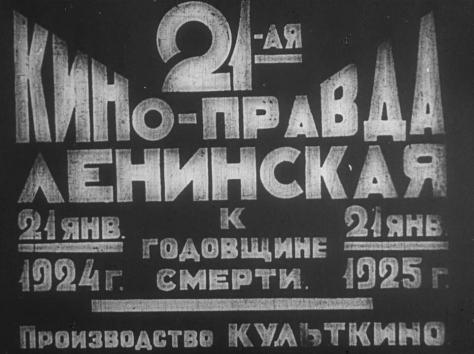
Kino Pravda 1

Kino Pravda (1925) – Dziga Vertov

Kino-Pravda

Dziga Vertov was central to the SovietKino-Pravda (literally, “cinematic truth”) newsreel series of the 1920s. Vertov believed the camera—with its varied lenses, shot-counter shot editing, time-lapse, ability to slow motion, stop motion and fast-motion—could render reality more accurately than the human eye, and made a film philosophy out of it.
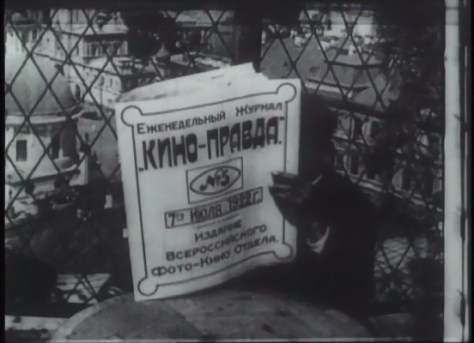
Kino Pravda 2

Kino Pravda (1922)

Newsreel tradition

The newsreel tradition is important in documentary film; newsreels were also sometimes staged but were usually re-enactments of events that had already happened, not attempts to steer events as they were in the process of happening. For instance, much of the battle footage from the early 20th century was staged; the cameramen would usually arrive on site after a major battle and re-enact scenes to film them.
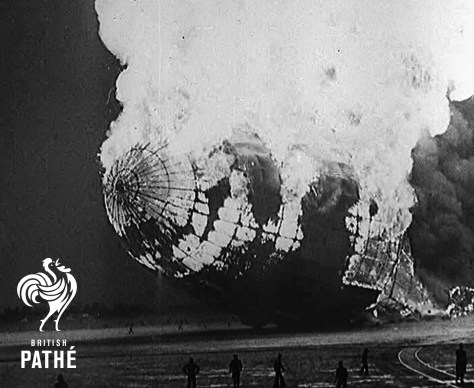
Pathe Newsreels 1

British Pathe Newsreel 

1920s–1940s

The propagandist tradition consists of films made with the explicit purpose of persuading an audience of a point. One of the most celebrated and controversial propaganda films is Leni Riefenstahl‘s film Triumph of the Will (1935), which chronicled the 1934 Nazi Party Congress and was commissioned by Adolf Hitler. Leftist filmmakers Joris Ivens and Henri Storck directed Borinage (1931) about the Belgian coal mining region. Luis Buñuel directed a “surrealist” documentary Las Hurdes (1933).
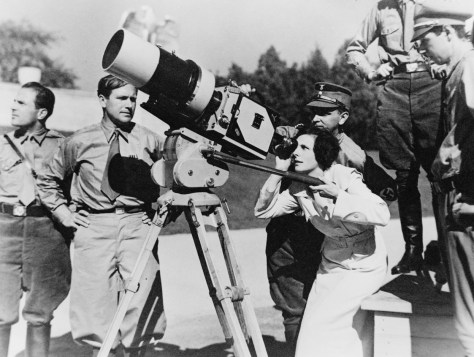
Triumph of the Will 1

Leni Riefenstahl filming Triumph of the Will (1935)
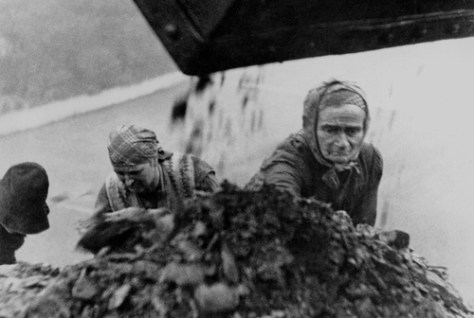
Borinage 1

Borinage (1934) – Joris Ivens

Land Without Bread 1

Las Hurdes (1933) – Luis Bunuel

Pare Lorentz‘s The Plow That Broke the Plains (1936) and The River (1938) and Willard Van Dyke‘s The City (1939) are notable New Deal productions, each presenting complex combinations of social and ecological awareness, government propaganda, and leftist viewpoints. Frank Capra‘s Why We Fight (1942–1944) series was a newsreel series in the United States, commissioned by the government to convince the U.S. public that it was time to go to war. Constance Bennett and her husband Henri de la Falaise produced two feature-length documentaries, Legong: Dance of the Virgins (1935) filmed in Bali, and Kilou the Killer Tiger (1936) filmed in Indochina.
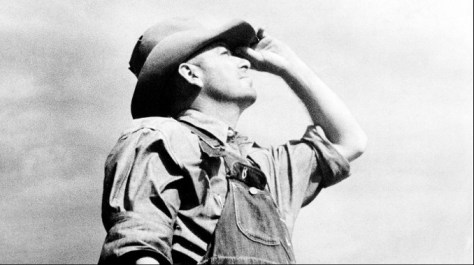
Plow 1

The Plow That Broke The Plains (1936)
City The 1

The City (1939)

Legong 1

Legong (1935)

Capra and Ford 1

Frank Capra and John Ford – Why We Fight (1942-1944)

In Canada, the Film Board, set up by John Grierson, was created for the same propaganda reasons. It also created newsreels that were seen by their national governments as legitimate counter-propaganda to the psychological warfare of Nazi Germany (orchestrated by Joseph Goebbels).

World Union 1

Conference of “World Union of documentary films” in 1948 Warsaw featured famous directors of the era: Basil Wright (on the left), Elmar Klos, Joris Ivens (2nd from the right), and Jerzy Toeplitz.

In Britain, a number of different filmmakers came together under John Grierson. They became known as the Documentary Film Movement.

Grierson, Alberto Cavalcanti, Harry Watt, Basil Wright, and Humphrey Jennings amongst others succeeded in blending propaganda, information, and education with a more poetic aesthetic approach to documentary. Examples of their work include Drifters (John Grierson), Song of Ceylon (Basil Wright), Fires Were Started, and A Diary for Timothy (Humphrey Jennings). Their work involved poets such as W. H. Auden, composers such as Benjamin Britten, and writers such as J. B. Priestley. Among the best known films of the movement are Night Mail and Coal Face.
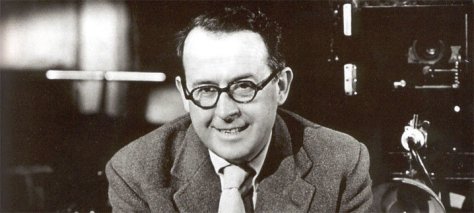
Cavalcanti Alberto 1

Alberto Cavalcanti

Watt Harry 1

Harry Watt

Wright Basil 1

Basil Wright

Jennings Humphrey 1

Humphrey Jennings

Night Mail 1

Night Mail (1935)

Diary for Timothy  1.jpg

A Diary For Timothy (1945)

1950s–1970s
Cinema Verite 1

Cinéma-vérité

Cinéma vérité (or the closely related direct cinema) was dependent on some technical advances in order to exist: light, quiet and reliable cameras, and portable sync sound.

Cinéma vérité and similar documentary traditions can thus be seen, in a broader perspective, as a reaction against studio-based film production constraints. Shooting on location, with smaller crews, would also happen in the French New Wave, the filmmakers taking advantage of advances in technology allowing smaller, handheld cameras and synchronized sound to film events on location as they unfolded.
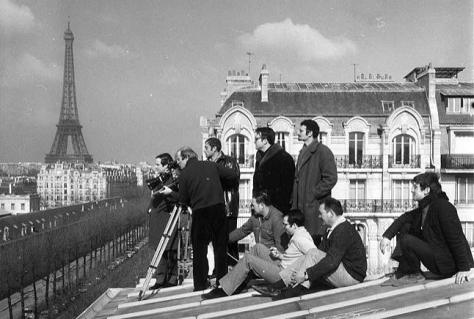
French New Wave 1

French New Wave

Although the terms are sometimes used interchangeably, there are important differences between cinéma vérité (Jean Rouch) and the North American “Direct Cinema” (or more accurately “Cinéma direct“), pioneered by, among others, Canadians Allan King, Michel Brault, and Pierre Perrault,[citation needed] and Americans Robert Drew, Richard Leacock, Frederick Wiseman, and Albert and David Maysles.
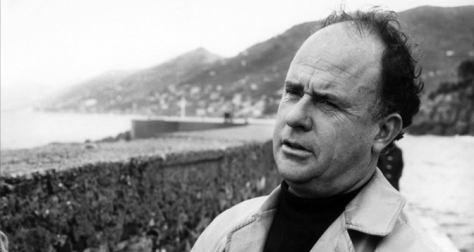
Rouch Jean 1

Jean Rouche

King Alan 1

Alan King

Leacock Richard 1

Richard Leacock

U.S. documentary filmmaker Albert Maysles works in his office in New York

Albert Maysles

Wiseman Frederick 1

Frederick Wiseman

The directors of the movement take different viewpoints on their degree of involvement with their subjects. Kopple and Pennebaker, for instance, choose non-involvement (or at least no overt involvement), and Perrault, Rouch, Koenig, and Kroitor favor direct involvement or even provocation when they deem it necessary.
Kopple Barbara 1

Barbara Kopple

D A Pennbaker

D A Pennebaker

The films Chronicle of a Summer (Jean Rouch), Dont Look Back (D. A. Pennebaker), Grey Gardens (Albert and David Maysles), Titicut Follies (Frederick Wiseman), Primary and Crisis: Behind a Presidential Commitment (both produced by Robert Drew), Harlan County, USA (directed by Barbara Kopple), Lonely Boy (Wolf Koenig and Roman Kroitor) are all frequently deemed cinéma vérité films.

The fundamentals of the style include following a person during a crisis with a moving, often handheld, camera to capture more personal reactions. There are no sit-down interviews, and the shooting ratio (the amount of film shot to the finished product) is very high, often reaching 80 to one. From there, editors find and sculpt the work into a film. The editors of the movement—such as Werner Nold, Charlotte Zwerin, Muffie Myers, Susan Froemke, and Ellen Hovde—are often overlooked, but their input to the films was so vital that they were often given co-director credits.

Famous cinéma vérité/direct cinema films include Les Raquetteurs,[19]Showman, Salesman, Near Death, and The Children Were Watching.
Chronicle of a Summer 1

Chronicle of A Summer (1961)

Don t Look Back 1

Don’t Look Back (1967)

Grey Gardens 1

Grey Gardens (1975)

Titicut follies 1

Titticut Follies (1967)

Harlan County 1

Harlan County USA (1975)

Political weapons

In the 1960s and 1970s, documentary film was often conceived as a political weapon against neocolonialism and capitalism in general, especially in Latin America, but also in a changing Quebec society. La Hora de los hornos (The Hour of the Furnaces, from 1968), directed by Octavio Getino and Arnold Vincent Kudales Sr., influenced a whole generation of filmmakers. Among the many political documentaries produced in the early 1970s was “Chile: A Special Report,” public television’s first in-depth expository look of the September 1973 overthrow of the Salvador Allende government in Chile by military leaders under Augusto Pinochet, produced by documentarians Ari Martinez and José Garcia.
Hour of the Furnaces 1

The Hour of the Furnaces (1968)

Modern

Box office analysts have noted that this film genre has become increasingly successful in theatrical release with films such as Fahrenheit 9/11, Super Size Me, Food, Inc., Earth, March of the Penguins, Religulous, and An Inconvenient Truth among the most prominent examples. Compared to dramatic narrative films, documentaries typically have far lower budgets which makes them attractive to film companies because even a limited theatrical release can be highly profitable.
Farrenheit 9 11 1

Fahrenheit 9/11 (2004)

Inconvenient Truth An 1

An Inconvenient Truth (2006)

The nature of documentary films has expanded in the past 20 years from the cinema verité style introduced in the 1960s in which the use of portable camera and sound equipment allowed an intimate relationship between filmmaker and subject. The line blurs between documentary and narrative and some works are very personal, such as the late Marlon Riggs‘s Tongues Untied (1989) and Black Is…Black Ain’t (1995), which mix expressive, poetic, and rhetorical elements and stresses subjectivities rather than historical materials.[20]
Black 1

Black is, black ain’t… (1995)

Historical documentaries, such as the landmark 14-hour Eyes on the Prize: America’s Civil Rights Years (1986—Part 1 and 1989—Part 2) by Henry Hampton, Four Little Girls (1997) by Spike Lee, and The Civil War by Ken Burns, UNESCO awarded independent film on slavery 500 Years Later, expressed not only a distinctive voice but also a perspective and point of views. Some films such as The Thin Blue Line by Errol Morris incorporated stylized re-enactments, and Michael Moore‘s Roger & Me placed far more interpretive control with the director. The commercial success of these documentaries may derive from this narrative shift in the documentary form, leading some critics to question whether such films can truly be called documentaries; critics sometimes refer to these works as “mondo films” or “docu-ganda.”[21] However, directorial manipulation of documentary subjects has been noted since the work of Flaherty, and may be endemic to the form due to problematic ontological foundations.
Four Little Girls 1

Four Little Girls (1997) – Spike Lee

Civil War Ken Burns 1

The Civil War (1990) – Ken Burns

Thin Blue Line 1

Thin Blue Line (1988) – Errol Morris

Documentary filmmakers are increasingly utilizing social impact campaigns with their films.[22] Social impact campaigns seek to leverage media projects by converting public awareness of social issues and causes into engagement and action, largely by offering the audience a way to get involved.[23] Examples of such documentaries include Kony 2012, Salam Neighbor, Gasland, Living on One Dollar, and Girl Rising.

Although documentaries are financially more viable with the increasing popularity of the genre and the advent of the DVD, funding for documentary film production remains elusive. Within the past decade, the largest exhibition opportunities have emerged from within the broadcast market, making filmmakers beholden to the tastes and influences of the broadcasters who have become their largest funding source.[24]

Modern documentaries have some overlap with television forms, with the development of “reality television” that occasionally verges on the documentary but more often veers to the fictional or staged. The making-of documentary shows how a movie or a computer game was produced. Usually made for promotional purposes, it is closer to an advertisement than a classic documentary.

Voices of Iraq 1

Voices of Iraq (2004) – Kunert/Manes

Modern lightweight digital video cameras and computer-based editing have greatly aided documentary makers, as has the dramatic drop in equipment prices. The first film to take full advantage of this change was Martin Kunert and Eric ManesVoices of Iraq, where 150 DV cameras were sent to Iraq during the war and passed out to Iraqis to record themselves.

National Geographic television collaborates local video production agencies to present the best content for viewers, APV delivered modern documentaries programming focussed on Hong Kong Local region with collaborating National Geographic.

Without words

Films in the documentary form without words have been made. From 1982, the Qatsi trilogy and the similar Baraka could be described as visual tone poems, with music related to the images, but no spoken content. Koyaanisqatsi (part of the Qatsi trilogy) consists primarily of slow motion and time-lapse photography of cities and many natural landscapes across the United States. Baraka tries to capture the great pulse of humanity as it flocks and swarms in daily activity and religious ceremonies.
Koyaniquatsi 1

Koyaanisqatsi (1982) – Godfrey Reggio

Bodysong was made in 2003 and won a British Independent Film Award for “Best British Documentary.”

The 2004 film Genesis shows animal and plant life in states of expansion, decay, sex, and death, with some, but little, narration.

Genesis 1

Genesis (2004)

Narration styles

Voice-over narrator

The traditional style for narration is to have a dedicated narrator read a script which is dubbed onto the audio track. The narrator never appears on camera and may not necessarily have knowledge of the subject matter or involvement in the writing of the script.

Silent narration

This style of narration uses title screens to visually narrate the documentary. The screens are held for about 5–10 seconds to allow adequate time for the viewer to read them. They are similar to the ones shown at the end of movies based on true stories, but they are shown throughout, typically between scenes.

Hosted narrator

In this style, there is a host who appears on camera, conducts interviews, and who also does voice-overs.
Look of Silence The 1

The Look of Silence (2014)  Joshua Oppenheimer

Other forms

Docufiction

Docufiction is a hybridgenre from two basic ones, fiction film and documentary, practiced since the first documentary films were made.

Fake-fiction

Fake-fiction is a genre which deliberately presents real, unscripted events in the form of a fiction film, making them appear as staged. The concept was introduced[25] by Pierre Bismuth to describe his 2016 film Where is Rocky II?.
Where is Rocky 2 1

Where is Rocky 2 (2016)  Pierre Bismuth

DVD documentary

A DVD documentary is a documentary film of indeterminate length that has been produced with the sole intent of releasing it for direct sale to the public on DVD(s), as different from a documentary being made and released first on television or on a cinema screen (a.k.a. theatrical release) and subsequently on DVD for public consumption.

This form of documentary release is becoming more popular and accepted as costs and difficulty with finding TV or theatrical release slots increases. It is also commonly used for more ‘specialist’ documentaries, which might not have general interest to a wider TV audience. Examples are military, cultural arts, transport, sports, etc..

Compilation films

Compilation films were pioneered in 1927 by Esfir Schub with The Fall of the Romanov Dynasty. More recent examples include Point of Order (1964), directed by Emile de Antonio about the McCarthy hearings, and The Atomic Cafe which is made entirely out of found footage that various agencies of the U.S. government made about the safety of nuclear radiation (for example, telling troops at one point that it is safe to be irradiated as long as they keep their eyes and mouths shut). Similarly, The Last Cigarette combines the testimony of various tobacco company executives before the U.S. Congress with archival propaganda extolling the virtues of smoking.
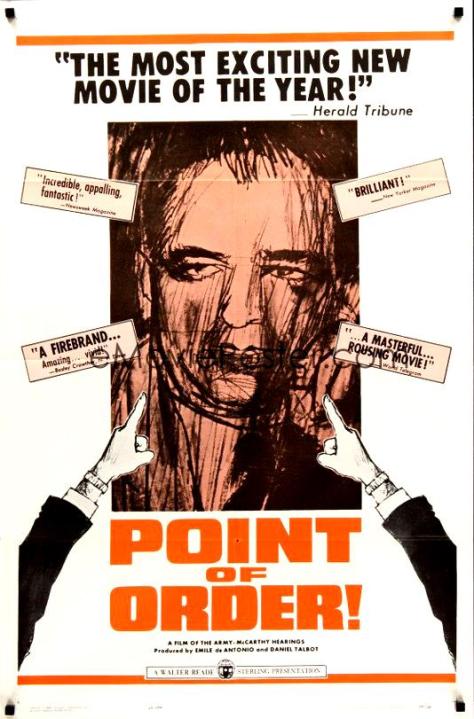
Point of Order 1

Point of Order (1964)  Emile De Antonio

Poetic documentaries, which first appeared in the 1920s, were a sort of reaction against both the content and the rapidly crystallizing grammar of the early fiction film. The poetic mode moved away from continuity editing and instead organized images of the material world by means of associations and patterns, both in terms of time and space.

Well-rounded characters—”lifelike people”—were absent; instead, people appeared in these films as entities, just like any other, that are found in the material world. The films were fragmentary, impressionistic, lyrical. Their disruption of the coherence of time and space—a coherence favored by the fiction films of the day—can also be seen as an element of the modernist counter-model of cinematic narrative. The “real world”—Nichols calls it the “historical world”—was broken up into fragments and aesthetically reconstituted using film form. Examples of this style include Joris Ivens’ Rain (1928), which records a passing summer shower over Amsterdam; László Moholy-Nagy’s Play of Light: Black, White, Grey (1930), in which he films one of his own kinetic sculptures, emphasizing not the sculpture itself but the play of light around it; Oskar Fischinger’s abstract animated films; Francis Thompson’s N.Y., N.Y. (1957), a city symphony film; and Chris Marker’s Sans Soleil (1982).
Sans Solei 1


Expository documentaries speak directly to the viewer, often in the form of an authoritative commentary employing voiceover or titles, proposing a strong argument and point of view. These films are rhetorical, and try to persuade the viewer. (They may use a rich and sonorous male voice.) The (voice-of-God) commentary often sounds ‘objective’ and omniscient. Images are often not paramount; they exist to advance the argument. The rhetoric insistently presses upon us to read the images in a certain fashion. Historical documentaries in this mode deliver an unproblematic and ‘objective’ account and interpretation of past events.

Examples: TV shows and films like Biography, America’s Most Wanted, many science and nature documentaries, Ken Burns’ The Civil War (1990), Robert Hughes’ The Shock of the New (1980), John Berger’s Ways Of Seeing (1974), Frank Capra’s wartime Why We Fight series, and Pare Lorentz’s The Plow That Broke The Plains (1936).
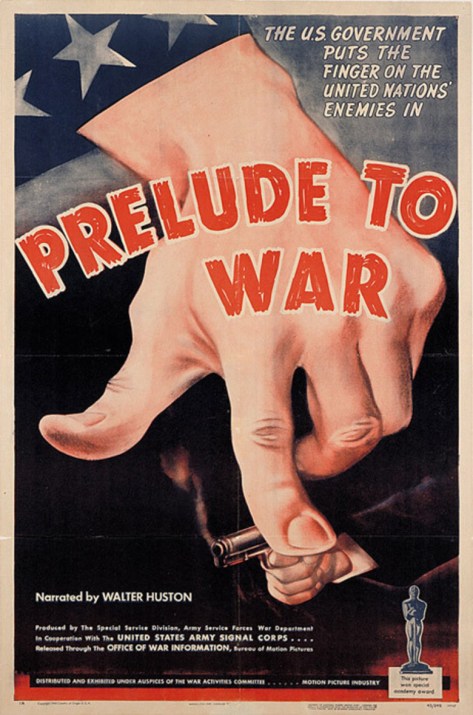
Prelude to War 1

Prelude to War – Why We Fight (1942) Frank Capra

Observational

Observational documentaries attempt to simply and spontaneously observe lived life with a minimum of intervention. Filmmakers who worked in this subgenre often saw the poetic mode as too abstract and the expository mode as too didactic. The first observational docs date back to the 1960s; the technological developments which made them possible include mobile lighweight cameras and portable sound recording equipment for synchronized sound. Often, this mode of film eschewed voice-over commentary, post-synchronized dialogue and music, or re-enactments. The films aimed for immediacy, intimacy, and revelation of individual human character in ordinary life situations.

Types

Participatory documentaries believe that it is impossible for the act of filmmaking to not influence or alter the events being filmed. What these films do is emulate the approach of the anthropologist: participant-observation. Not only is the filmmaker part of the film, we also get a sense of how situations in the film are affected or altered by their presence. Nichols: “The filmmaker steps out from behind the cloak of voice-over commentary, steps away from poetic meditation, steps down from a fly-on-the-wall perch, and becomes a social actor (almost) like any other. (Almost like any other because the filmmaker retains the camera, and with it, a certain degree of potential power and control over events.)” The encounter between filmmaker and subject becomes a critical element of the film. Rouch and Morin named the approach cinéma vérité, translating Dziga Vertov’s kinopravda into French; the “truth” refers to the truth of the encounter rather than some absolute truth.

Reflexive documentaries do not see themselves as a transparent window on the world; instead, they draw attention to their own constructedness, and the fact that they are representations. How does the world get represented by documentary films? This question is central to this subgenre of films. They prompt us to “question the authenticity of documentary in general.” It is the most self-conscious of all the modes, and is highly skeptical of ‘realism’. It may use Brechtian alienation strategies to jar us, in order to ‘defamiliarize’ what we are seeing and how we are seeing it.

Performative documentaries stress subjective experience and emotional response to the world. They are strongly personal, unconventional, perhaps poetic and/or experimental, and might include hypothetical enactments of events designed to make us experience what it might be like for us to possess a certain specific perspective on the world that is not our own, e.g. that of black, gay men in Marlon Riggs’s Tongues Untied (1989) or Jenny Livingston’s Paris Is Burning (1991). This subgenre might also lend itself to certain groups (e.g. women, ethnic minorities, gays and lesbians, etc.) to ‘speak about themselves.’ Often, a battery of techniques, many borrowed from fiction or avant-garde films, are used. Performative docs often link up personal accounts or experiences with larger political or historical realities.
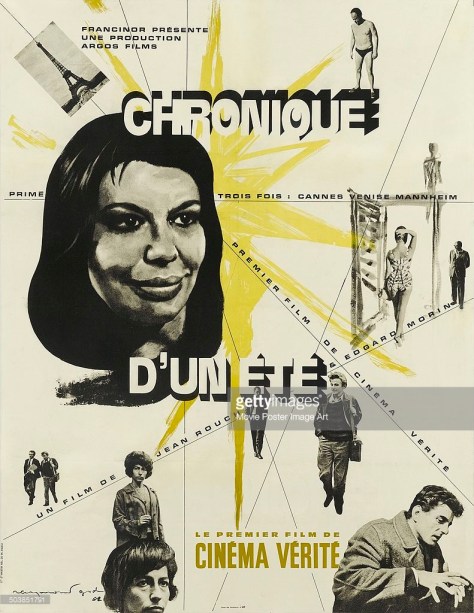
Chronique 1

Chronique D’Un Ete (1960)  Jean Rouch and Edgar Morin

Translation

There are several challenges associated with translation of documentaries. The main two are working conditions and problems with terminology.

Working conditions

Documentary translators very often have to meet tight deadlines. Normally, the translator has between five and seven days to hand over the translation of a 90-minute programme. Dubbing studios typically give translators a week to translate a documentary, but in order to earn a good salary, translators have to deliver their translations in a much shorter period, usually when the studio decides to deliver the final programme to the client sooner or when the broadcasting channel sets a tight deadline, e.g. on documentaries discussing the latest news.[26]

Another problem is the lack of postproduction script or the poor quality of the transcription. A correct transcription is essential for a translator to do their work properly, however many times the script is not even given to the translator, which is a major impediment since documentaries are characterised by “the abundance of terminological units and very specific proper names”.[27] When the script is given to the translator, it is usually poorly transcribed or outright incorrect making the translation unnecessary difficult and demanding because all of the proper names and specific terminology have to be correct in a documentary programme in order for it to be a reliable source of information, hence the translator has to check every term on their own. Such mistakes in proper names are for instance: “Jungle Reinhard instead of Django Reinhart, Jorn Asten instead of Jane Austen, and Magnus Axle instead of Aldous Huxley”.[27]
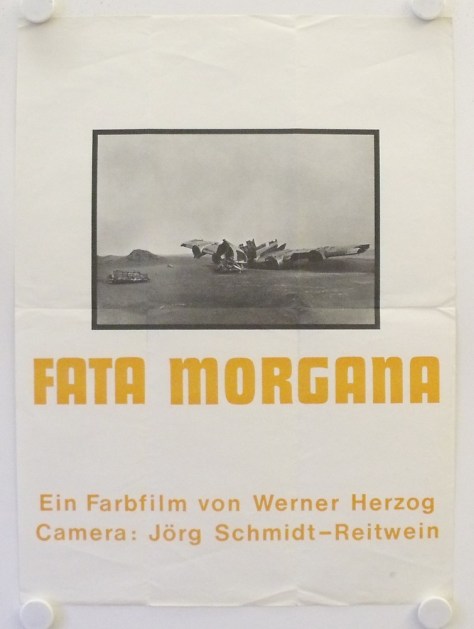
Fatamorgana 1

Fata Morgana (1971)  Werner Herzog – Original Release German Poster (1971)

Terminology

The process of translation of a documentary programme requires working with very specific, often scientific terminology. Documentary translators usually are not specialist in a given field. Therefore, they are compelled to undertake extensive research whenever asked to make a translation of a specific documentary programme in order to understand it correctly and deliver the final product free of mistakes and inaccuracies. Generally, documentaries contain a large amount of specific terms, with which translators have to familiarise themselves on their own, for example:

The documentary Beetles, Record Breakers makes use of 15 different terms to refer to beetles in less than 30 minutes (longhorn beetle, cellar beetle, stag beetle, burying beetle or gravediggers, sexton beetle, tiger beetle, bloody nose beetle, tortoise beetle, diving beetle, devil’s coach horse, weevil, click beetle, malachite beetle, oil beetle, cockchafer), apart from mentioning other animals such as horseshoe bats or meadow brown butterflies.[28]

This poses a real challenge for the translators because they have to render the meaning, i.e. find an equivalent, of a very specific, scientific term in the target language and frequently the narrator uses a more general name instead of a specific term and the translator has to rely on the image presented in the programme to understand which term is being discussed in order to transpose it in the target language accordingly.[29] Additionally, translators of minorised languages often have to face another problem: some terms may not even exist in the target language. In such case, they have to create new terminology or consult specialists to find proper solutions. Also, sometimes the official nomenclature differs from the terminology used by actual specialists, which leaves the translator to decide between using the official vocabulary that can be found in the dictionary, or rather opting for spontaneous expressions used by real experts in real life situations.[30]
Precinct Seven Five 1

The Seven Five/ Precinct Seven Five (2014)  Tiller Russell

See also

Some documentary film awards
Grierson Awards 1

Grierson Awards 

Notes and references

  1. Jump up^ oed.com
  2. Jump up^ Nichols, Bill. ‘Foreword’, in Barry Keith Grant and Jeannette Sloniowski (eds.) Documenting The Documentary: Close Readings of Documentary Film and Video. Detroit: Wayne State University Press, 1997
  3. Jump up^ Scott MacKenzie, Film Manifestos and Global Cinema Cultures: A Critical Anthology, Univ of California Press 2014, ISBN 9780520957411, p.520
  4. Jump up^ James Chapman, “Film and History. Theory and History” part “Film as historical source” p.73-75, Palgrave Macmillan, 2013, ISBN 9781137367327
  5. Jump up^ Ann Curthoys, Marilyn Lake Connected worlds: history in transnational perspective, Volume 2004 p.151. Australian National University Press
  6. Jump up^ Re-Thinking Grierson: The Ideology of John Grierson
  7. Jump up^ Pare Lorentz Film Library – FDR and Film
  8. Jump up^ Larry Ward (Fall 2008). “Introduction” (PDF). Lecture Notes for the BA in RadioTVFilm (RTVF). 375: Documentary Film & Television. California State University, Fullerton (College of communications): 4, slide 12.
  9. Jump up^ Charles Ford, Robert Hammond: Polish Film: A Twentieth Century History. McFarland, 2005. ISBN 9781476608037, p.10.
  10. Jump up^ Journal of Film Preservation, nr. 70, November 2005.
  11. Jump up^ Mircea Dumitrescu, O privire critică asupra filmului românesc, Brașov, 2005, ISBN 978-973-9153-93-5
  12. Jump up^ Rîpeanu, Bujor T. Filmul documentar 1897–1948, Bucharest, 2008, ISBN 978-973-7839-40-4
  13. Jump up^ Ţuţui, Marian, A short history of the Romanian films at the Romanian National Cinematographic Center. Archived April 11, 2008, at the Wayback Machine.
  14. Jump up^ The Works of Gheorghe Marinescu, 1967 report.
  15. Jump up^ Excerpts of prof. dr. Marinescu’s science films. Archived February 26, 2015, at the Wayback Machine.
  16. Jump up^ Miriam Hansen, Babel and Babylon: Spectatorship in American Silent Film, 2005.
  17. Jump up^ Rees, A.L. (2011). A History of Experimental Film and Video (2nd Edition). Palgrave Macmillan. ISBN 978-1-84457-436-0.
  18. Jump up^ Grierson, John. ‘First Principles of Documentary’, in Kevin Macdonald & Mark Cousins (eds.) Imagining Reality: The Faber Book of Documentary. London: Faber and Faber, 1996
  19. Jump up^ Les raquetteurs – NFB – Collection
  20. Jump up^ Struggles for Representation African American Documentary Film and Video, edited by Phyllis R. Klotman and Janet K. Cutler,
  21. Jump up^ Wood, Daniel B. (2 June 2006). “In ‘docu-ganda’ films, balance is not the objective”. Christian Science Monitor. Retrieved 2006-06-06.
  22. Jump up^ Johnson, Ted (2015-06-19). “AFI Docs: Filmmakers Get Savvier About Fueling Social Change”. Variety. Retrieved 2016-06-23.
  23. Jump up^ “social impact campaigns”. http://www.azuremedia.org. Retrieved 2016-06-23.
  24. Jump up^ indiewire.com, “Festivals: Post-Sundance 2001; Docs Still Face Financing and Distribution Challenges.” February 8, 2001.
  25. Jump up^ Campion, Chris (2015-02-11). “Where is Rocky II? The 10-year desert hunt for Ed Ruscha’s missing boulder”. The Guardian. ISSN 0261-3077. Retrieved 2016-10-22.
  26. Jump up^ Matamala, A. (2009). Main Challenges in the Translation of Documentaries. In J. Cintas (Ed.), New Trends in Audiovisual Translation (pp. 109-120). Bristol, UK: Multilingual Matters, p. 110-111.
  27. ^ Jump up to:a b Matamala, A. (2009). Main Challenges in the Translation of Documentaries. In J. Cintas (Ed.), New Trends in Audiovisual Translation (pp. 109-120). Bristol, UK: Multilingual Matters, p. 111
  28. Jump up^ Matamala, A. (2009). Main Challenges in the Translation of Documentaries. In J. Cintas (Ed.), New Trends in Audiovisual Translation (pp. 109-120). Bristol, UK: Multilingual Matters, p. 113
  29. Jump up^ Matamala, A. (2009). Main Challenges in the Translation of Documentaries. In J. Cintas (Ed.), New Trends in Audiovisual Translation (pp. 109-120). Bristol, UK: Multilingual Matters, p. 113-114
  30. Jump up^ Matamala, A. (2009). Main Challenges in the Translation of Documentaries. In J. Cintas (Ed.), New Trends in Audiovisual Translation (pp. 109-120). Bristol, UK: Multilingual Matters, p. 114-115
Grizzly Man 1

Grizzly Man (2005)  Werner Herzog

Sources and bibliography

Search for Reality 1

Ethnographic film

  • Emilie de Brigard, “The History of Ethnographic Film,” in Principles of Visual Anthropology, ed. Paul Hockings. Berlin and New York: Mouton de Gruyter, 1995, pp. 13–43.
  • Leslie Devereaux, “Cultures, Disciplines, Cinemas,” in Fields of Vision. Essays in Film Studies, Visual Anthropology and Photography, ed. Leslie Devereaux & Roger Hillman. Berkeley: University of California Press, 1995, pp. 329–339.
  • Faye Ginsburg, Lila Abu-Lughod and Brian Larkin (eds.), Media Worlds: Anthropology on New Terrain. Berkeley, CA: University of California Press, 2002. ISBN 978-0-520-23231-0.
  • Anna Grimshaw, The Ethnographer’s Eye: Ways of Seeing in Modern Anthropology. Cambridge, UK: Cambridge University Press, 2001. ISBN 978-0-521-77310-2.
  • Karl G. Heider, Ethnographic Film. Austin: University of Texas Press, 1994.
  • Luc de Heusch, Cinéma et Sciences Sociales, Paris: UNESCO, 1962. Published in English as The Cinema and Social Science. A Survey of Ethnographic and Sociological Films. UNESCO, 1962.
  • Fredric Jameson, Signatures of the Visible. New York & London: Routledge, 1990.
  • Pierre-L. Jordan, Premier Contact-Premier Regard, Marseille: Musées de Marseille. Images en Manoeuvres Editions, 1992.
  • André Leroi-Gourhan, “Cinéma et Sciences Humaines. Le Film Ethnologique Existe-t-il?,” Revue de Géographie Humaine et d’Ethnologie 3 (1948), pp. 42–50.
  • David MacDougall, Transcultural Cinema. Princeton, NJ: Princeton University Press, 1998. ISBN 978-0-691-01234-6.
  • David MacDougall, “Whose Story Is It?,” in Ethnographic Film Aesthetics and Narrative Traditions, ed. Peter I. Crawford and Jan K. Simonsen. Aarhus, Intervention Press, 1992, pp. 25–42.
  • Fatimah Tobing Rony, The Third Eye: Race, Cinema and Ethnographic Spectacle. Durham, NC: Duke University Press, 1996. ISBN 978-0-8223-1840-8.
  • Georges Sadoul, Histoire Générale du Cinéma. Vol. 1, L’Invention du Cinéma 1832–1897. Paris: Denöel, 1977, pp. 73–110.
  • Pierre Sorlin, Sociologie du Cinéma, Paris: Aubier Montaigne, 1977, pp. 7–74.
  • Charles Warren, “Introduction, with a Brief History of Nonfiction Film,” in Beyond Document. Essays on Nonfiction Film, ed. Charles Warren. Hanover and London: Wesleyan University Press, 1996, pp. 1–22.
  • Ismail Xavier, “Cinema: Revelação e Engano,” in O Olhar, ed. Adauto Novaes. São Paulo: Companhia das Letras, 1993, pp. 367–384.
American Ethnographic Film 1

Andrei Tarkovsky Season on Film4 April/May 2017


Andrei Tarkovsky Season

On the 85th anniversary of his birth, Film4 begins a season of films by the legendary Russian director. All of Tarkovsky’s seven feature films will play (non-chronologically) throughout April and May. All films will be available to view on All4 after broadcast.

DATES

Tuesday 4th April, 12.10am – Andrei Rublev (1966)

Andrei-Rublev

A new, restored print of Andrei Tarkovsky’s disturbing portrait of a great icon painter in early 15th-century Russia, a war-torn period that saw the country in upheaval.

Wednesday 12th, 1.25am – Ivan’s Childhood (1962)

ivans-childhood-review.jpg

Andrei Tarkovsky’s feature debut blends impressionism and stark realism to tell the tale of a quest for vengeance during the Second World War.

Thursday 20th, 12.40am – Solaris (1972)

solaris-1

Andrei Tarkovsky’s transcendent sci-fi classic, a moving and unsettling vision of memory and humanity.

Monday 24th, 12.40am – Stalker (1979)

stalkerdog

Following Solaris, Tarkovsky’s second foray into the sci-fi genre: a surreal and disturbing vision of the future, in which a scientist, a writer and a Stalker attempt to navigate the bleak and devastated terrain of the Zone.

Date & time tbc – Mirror (1975)

c07170b2bb7108eda8729902fa2fdfb5

Andrei Tarkovsky’s most autobiographical work, in which he reflects upon his own childhood and the destiny of the Russian people.

Date & time tbc – Nostalgia (1983)

5dbd94ef001d559fea3235c2463af581

Tarkovsky’s first film to be made outside of Russia explores the melancholy of the expatriate, as a Russian poet in a Tuscan village is haunted by memories of his wife, children and homeland.

Date & time tbc – The Sacrifice (1986)

sacrifice-andrei-tarkovsky

Tarkovsky’s Cannes prize-winning final film: a mystical and enigmatic parable that unfolds in the hours before a nuclear holocaust.

TO VIEW:

Access Film4

http://www.channel4.com/programmes/film4

TO VIEW ANYTIME:

Access All 4

http://www.channel4.com/programmes/catchup/


Tarkovsky 2

Experimental Film


Experimental film

Experiment 1

Prepared by Daniel B Miller

Experimental film, experimental cinema or avant-garde cinema is a mode of filmmaking that rigorously re-evaluates cinematic conventions and explores non-narrative forms and alternatives to traditional narratives or methods of working.[1] Many experimental films, particularly early ones, relate to arts in other disciplines: painting, dance, literature and poetry,[2] or arise from research and development of new technical resources.[3]
Lost 1

While some experimental films have been distributed through mainstream channels or even made within commercial studios, the vast majority have been produced on very low budgets with a minimal crew or a single person and are either self-financed or supported through small grants.[4]

Experimental filmmakers generally begin as amateurs, and some used experimental films as a springboard into commercial film making or transitioned into academic positions. The aim of experimental filmmaking is usually to render the personal vision of an artist, or to promote interest in new technology rather than to entertain or to generate revenue, as is the case with commercial films.

Corso 1

Definition

The term describes a range of filmmaking styles that are generally quite different from, and often opposed to, the practices of mainstream commercial and documentary filmmaking. Avant-garde is also used, for the films shot in the twenties in the field of history’s avant-gardes currents in France, Germany or Russia, to describe this work, and “underground” was used in the sixties, though it has also had other connotations. Today the term “experimental cinema” prevails, because it’s possible to make experimental films without the presence of any avant-garde movement in the cultural field.

La Jette 1

While “experimental” covers a wide range of practice, an experimental film is often characterized by the absence of linear narrative, the use of various abstracting techniques—out-of-focus, painting or scratching on film, rapid editing—the use of asynchronous (non-diegetic) sound or even the absence of any sound track. The goal is often to place the viewer in a more active and more thoughtful relationship to the film. At least through the 1960s, and to some extent after, many experimental films took an oppositional stance toward mainstream culture.

La Jette 2

Most such films are made on very low budgets, self-financed or financed through small grants, with a minimal crew or, often a crew of only one person, the filmmaker. Some critics have argued that much experimental film is no longer in fact “experimental” but has in fact become a mainstream film genre.[5] Many of its more typical features—such as a non-narrative, impressionistic, or poetic approaches to the film’s construction—define what is generally understood to be “experimental”.[6]

History

The European avant-garde

Man Ray Films 1

Two conditions made Europe in the 1920s ready for the emergence of experimental film. First, the cinema matured as a medium, and highbrow resistance to the mass entertainment began to wane. Second, avant-garde movements in the visual arts flourished. The Dadaists and Surrealists in particular took to cinema. René Clair‘s Entr’acte (1924) featuring Francis Picabia, Marcel Duchamp, and Man Ray, and with music by Erik Satie, took madcap comedy into nonsequitur.

Richter 1

Artists Hans Richter, Jean Cocteau, Marcel Duchamp, Germaine Dulac, and Viking Eggeling all contributed Dadaist/Surrealist shorts. Fernand Léger, Dudley Murphy, and Man Ray created the film Ballet Mécanique (1924), sometimes described as Dadaist, Cubist, or Futurist. Duchamp created the abstract film Anémic Cinéma (1926).

Duchamps 1

Alberto Cavalcanti directed Rien que les heures (1926), Walter Ruttmann directed Berlin: Symphony of a Metropolis (1927), and Dziga Vertov filmed Man With a Movie Camera (1929), experimental “city symphonies” of Paris, Berlin, and Kiev, respectively.

Man With A Moving Camera 1

The most famous experimental film is generally considered to be Luis Buñuel and Salvador Dalí‘s Un chien andalou (1929). Hans Richter’s animated shorts, Oskar Fischinger‘s abstract films, and Len Lye‘s GPO films would be excellent examples of more abstract European avant-garde films.

Fischniger 1

Working in France, another group of filmmakers also financed films through patronage and distributed them through cine-clubs, yet they were narrative films not tied to an avant-garde school. Film scholar David Bordwell has dubbed these French Impressionists, and included Abel Gance, Jean Epstein, Marcel L’Herbier, and Dimitri Kirsanoff. These films combine narrative experimentation, rhythmic editing and camerawork, and an emphasis on character subjectivity.

La Roue 1

In 1952, the Lettrists avant-garde movement in France, caused riots at the Cannes Film Festival, when Isidore Isou‘s Traité de bave et d’éternité (also known as Venom and Eternity) was screened. After their criticism of Charlie Chaplin at the 1952 press conference in Paris for Chaplin’s Limelight, there was a split within the movement. The Ultra-Lettrists continued to cause disruptions when they announced the death of cinema and showed their new hypergraphical techniques. The most notorious film of which is Guy Debord‘s(Hurlements en Faveur de Sade) from 1952.

Venom and Eternity 1


The Soviet filmmakers, too, found a counterpart to modernist painting and photography in their theories of montage. The films of Dziga Vertov, Sergei Eisenstein, Lev Kuleshov, Alexander Dovzhenko, and Vsevolod Pudovkin were instrumental in providing an alternate model from that offered by classical Hollywood. While not experimental films per se, they contributed to the film language of the avant-garde.

Strike 1

Prewar and postwar American avant-garde: the birth of experimental cinema

The U.S. had some avant-garde films before World War II, such as Manhatta (1921) by Charles Sheeler and Paul Strand, and The Life and Death of 9413: a Hollywood Extra (1928) by Slavko Vorkapich and Robert Florey. However, much pre-war experimental film culture consisted of artists working, often in isolation, on film projects. Painter Emlen Etting (1905–1993) directed dance films in the early 1930s that are considered experimental. Commercial artist (Saturday Evening Post) and illustrator Douglass Crockwell (1904–1968)[7] made animations with blobs of paint pressed between sheets of glass in his studio at Glens Falls, New York.[8]


Life and Death of 1

In Rochester, New York, medical doctor and philanthropist James Sibley Watson and Melville Webber directed The Fall of the House of Usher (1928) and Lot in Sodom (1933). Harry Smith, Mary Ellen Bute, artist Joseph Cornell, and Christopher Young made several European-influenced experimental films. Smith and Bute were both influenced by Oskar Fischinger, as were many avant garde animators and filmmakers. In 1930 appears the magazine Experimental Cinema with, for the first time, the two words directly connected without any space between them.[9] The editors were Lewis Jacobs and David Platt. In October 2005, a large collection of films of that time were restored and re-released on DVD, titled Unseen Cinema: Early American Avant Garde Film 1894-1941.[10]

Fall of the House of Usher 1

With Slavko Vorkapich, John Hoffman made two visual tone poems, Moods of the Sea (aka Fingal’s Cave, 1941) and Forest Murmurs (1947). The former film is set to Felix Mendelssohn‘s Hebrides Overture and was restored in 2004 by film preservation expert David Shepard.

Moods of the Sea 1

Meshes of the Afternoon (1943) by Maya Deren and Alexander Hammid is considered by some to be one of the first important American experimental films. It provided a model for self-financed 16 mm production and distribution, one that was soon picked up by Cinema 16 and other film societies. Just as importantly, it established an aesthetic model of what experimental cinema could do. Meshes had a dream-like feel that hearkened to Jean Cocteau and the Surrealists, but equally seemed personal, new and American.

Deren Films 2


Early works by Kenneth Anger, Stan Brakhage, Shirley Clarke, Gregory Markopoulos, Jonas Mekas, Willard Maas, Marie Menken, Curtis Harrington, Sidney Peterson, Lionel Rogosin, and Earle M. Pilgrim followed in a similar vein. Significantly, many of these filmmakers were the first students from the pioneering university film programs established in Los Angeles and New York. In 1946, Frank Stauffacher started the “Art in Cinema” series of experimental films at the San Francisco Museum of Modern Art, where Oskar Fischinger’s films were featured in several special programs, influencing artists such as Jordan Belson and Harry Smith to make experimental animation.

Anger 1

Brakhage 1

wideangleofset

Makropulous 1

Dennis Hopper (as Johnny Drake) in NIGHT TIDE by Curtis Harrington

They set up “alternative film programs” at Black Mountain College (now defunct) and the San Francisco Art Institute. Arthur Penn taught at Black Mountain College, which points out the popular misconception in both the art world and Hollywood that the avant-garde and the commercial never meet. Another challenge to that misconception is the fact that late in life, after each’s Hollywood careers had ended, both Nicholas Ray and King Vidor made avant-garde films.

Anthology 1

The New American Cinema and Structural-Materialism

Main article: Structural film

The film society and self-financing model continued over the next two decades, but by the early 1960s, a different outlook became perceptible in the work of American avant-garde filmmakers. Artist Bruce Conner created early examples such as A Movie (1958) and Cosmic Ray (1962). As P. Adams Sitney has pointed out, in the work of Stan Brakhage and other American experimentalists of early period, film is used to express the individual consciousness of the maker, a cinematic equivalent of the first person in literature. Brakhage‘s Dog Star Man (1961–64) exemplified a shift from personal confessional to abstraction, and also evidenced a rejection of American mass culture of the time. On the other hand, Kenneth Anger added a rock sound track to his Scorpio Rising (1963) in what is sometimes said to be an anticipation of music videos, and included some camp commentary on Hollywood mythology. Jack Smith and Andy Warhol incorporated camp elements into their work, and Sitneyposited Warhol’s connection to structural film.

Brakhage Stan 1


Anger Kenneth 2

Mekas Jonas 1

Warhol 1

Some avant-garde filmmakers moved further away from narrative. Whereas the New American Cinema was marked by an oblique take on narrative, one based on abstraction, camp and minimalism, Structural-Materialist filmmakers like Hollis Frampton and Michael Snow created a highly formalist cinema that foregrounded the medium itself: the frame, projection, and most importantly, time. It has been argued that by breaking film down into bare components, they sought to create an anti-illusionist cinema, although Frampton’s late works owe a huge debt to the photography of Edward Weston, Paul Strand, and others, and in fact celebrate illusion. Further, while many filmmakers began making rather academic “structural films” following Film Cultures publication of an article by P. Adams Sitney in the late 1960s, many of the filmmakers named in the article objected to the term.

Holis Frampton 1

Michael Snow 1

A critical review of the structuralists appeared in a 2000 edition of the art journal Art In America. It examined structural-formalism as a conservative philosophy of filmmaking.

The 1960–70s and today. Time arts in the conceptual art landscape

Conceptual art in the 1970s pushed even further. Robert Smithson, a California-based artist, made several films about his earthworks and attached projects. Yoko Ono made conceptual films, the most notorious of which is Rape, which finds a woman and invades her life with cameras following her back to her apartment as she flees from the invasion. Around this time a new generation was entering the field, many of whom were students of the early avant-gardists. Leslie Thornton, Peggy Ahwesh, and Su Friedrich expanded upon the work of the structuralists, incorporating a broader range of content while maintaining a self-reflexive form.

Robert Smithson 1

Andy Warhol, the man behind Pop Art and a variety of other oral and art forms, made over 60 films throughout the 1960s, most of them experimental. In more recent years, filmmakers such as Craig Baldwin and James O’Brien (Hyperfutura) have made use of stock footage married to live action narratives in a form of mash-up cinema that has strong socio-political undertones.

Craig-Baldwin 1

Feminist avant-garde and other political offshoots

Laura Mulvey‘s writing and filmmaking launched a flourishing of feminist filmmaking based on the idea that conventional Hollywood narrative reinforced gender norms and a patriarchal gaze. Their response was to resist narrative in a way to show its fissures and inconsistencies. Chantal Akerman and Sally Potter are just two of the leading feminist filmmakers working in this mode in the 1970s. Video art emerged as a medium in this period, and feminists like Martha Rosler and Cecelia Condit took full advantage of it.

Laura Mulvey 1

Chantal Akerman 1

Sally Potter 1

In the 1980s feminist, gay and other political experimental work continued, with filmmakers like Barbara Hammer, Su Friedrich, Tracey Moffatt, Sadie Benning and Isaac Julien among others finding experimental format conducive to their questions about identity politics.

The queercore movement gave rise to a number experimental queer filmmakers such as G.B. Jones (a founder of the movement) in the 1990s and later Scott Treleaven, among others.

Barbara Hammer 1

Sue Friderich 1

Tracey Moffatt 1

Isaac Julienn 1

Experimental Film and the Academy

With very few exceptions, Curtis Harrington among them, the artists involved in these early movements remained outside of the mainstream commercial cinema and entertainment industry. A few taught occasionally, and then, starting in 1966, many became professors at universities such as the State Universities of New York, Bard College, California Institute of the Arts, the Massachusetts College of Art, University of Colorado at Boulder, and the San Francisco Art Institute.

Curtis Harrington 1

Many of the practitioners of experimental film do not in fact possess college degrees themselves, although their showings are prestigious. Some have questioned the status of the films made in the academy, but longtime film professors such as Stan Brakhage, Ken Jacobs, Ernie Gehr, and many others, continued to refine and expand their practice while teaching. The inclusion of experimental film in film courses and standard film histories, however, has made the work more widely known and more accessible.

Ernie Gehr 1

Exhibition and distribution

Jonas Mekas 1

Lithuanian artist Jonas Mekas, regarded as godfather of American avant-garde cinema

Beginning in 1946, Frank Stauffacher ran the “Art in Cinema” program of experimental and avant-garde films at the San Francisco Museum of Modern Art.

Frank Stauf acher 1

From 1949 to 1975, the Festival international du cinéma expérimental de Knokke-le-Zoute—located in Knokke-Heist, Belgium—was the most proeminant festival of experimental cinema in the World. It permits the discovery of American avant-garde in 1958 with Brakhage’s films and many others European and American filmmakers.


Knokke 2

From 1947 to 1963, the New York-based Cinema 16 functioned as the primary exhibitor and distributor of experimental film in the United States. Under the leadership of Amos Vogel and Marcia Vogel, Cinema 16 flourished as a nonprofit membership society committed to the exhibition of documentary, avant-garde, scientific, educational, and performance films to ever-increasing audiences.

Mekas 2

In 1962, Jonas Mekas and about 20 other film makers founded The Film-Makers’ Cooperative in New York City. Soon similar artists cooperatives were formed in other places: Canyon Cinema in San Francisco, the London Film-Makers’ Co-op, and Canadian Filmmakers Distribution Center.

Following the model of Cinema 16, experimental films have been exhibited mainly outside of commercial theaters in small film societies, microcinemas, museums, art galleries, archives and film festivals.

Cinema 16 1

Several other organizations in both Europe and North America helped develop experimental film. These included Anthology Film Archives in New York City, The Millennium Film Workshop, the British Film Institute in London, the National Film Board of Canada and the Collective for Living Cinema.

Some of the more popular film festivals, such as Ann Arbor Film Festival, the New York Film Festival‘s “Views from the Avant-Garde” Side Bar and the International Film Festival Rotterdam prominently feature experimental works.

NFT 1

The New York Underground Film Festival, Chicago Underground Film Festival, the LA Freewaves Experimental Media Arts Festival, MIX NYC the New York Experimental Lesbian and Gay Film Festival, and Toronto’s Images Festival also support this work and provide venues for films which would not otherwise be seen. There is some dispute about whether “underground” and “avant-garde” truly mean the same thing and if challenging non-traditional cinema and fine arts cinema are actually fundamentally related.[citation needed]

Venues such as Anthology Film Archives, San Francisco Cinematheque, Pacific Film Archive in Berkeley, California, Tate Modern, London and the Centre Pompidou in Paris often include historically significant experimental films and contemporary works. Screening series no longer in New York that featured experimental work include the Robert Beck Memorial Cinema, Ocularis and the Collective for Living Cinema.

Collective 1

Recently Pacific Film Archive eliminated their experimental Tuesday night program. A new curator (since 2000) of the Whitney Museum stated in a 2001 interview on Charlie Rose that he believed it was the responsibility of the Anthology Film Archives to show the work because the work is essentially unsellable and the Whitney was not interested in “renting” video art and films. He went on to intimate that it would fall out of favor in coming biennials. (PBS/Charlie Rose).[citation needed]However this statement appears irrelevant, as The Whitney has exhibited experimental film in exhibitions, installations, and screenings since then, e.g. screening series for the Summer of Love exhibition, films in biennials, and the installation of Oskar Fischinger’s Raumlichtkunst in 2012.

Some distributors of experimental film today include Le Collectif Jeune Cinema,[11]Cinédoc, and Light Cone [12] in Paris, Canyon Cinema in San Francisco, Canadian Filmmaker’s Distribution Centre, The Film-Makers’ Cooperative in New York, and Lux in London. Sixteen mm prints are still available through these organisations, and some archives. Center for Visual Music distributes curated film programs of experimental animation, including that of Oskar Fischinger, Jordan Belson, Mary Ellen Bute and others.

FMC_logo 1

All these associations and movements have permitted the birth and development of national experimental films and schools like “body cinema” (“Écoles du corps” or “Cinéma corporel”) and “post-structural” movements in France, and “structural/materialism” in England for example.[13]

Influences on commercial media

Though experimental film is known to a relatively small number of practitioners, academics and connoisseurs, it has influenced and continues to influence cinematography, visual effects and editing.

The genre of music video can be seen as a commercialization of many techniques of experimental film. Title design and television advertising have also been influenced by experimental film.

Godard 1

Jarman 1

Lynch and Laurentis 1

Many experimental filmmakers have also made feature films, and vice versa. Notable examples include Lars von Trier, Jørgen Leth, Alejandro Jodorowsky, Nikos Nikolaidis, Jean-Luc Godard, Steven Soderbergh, Kathryn Bigelow, Curtis Harrington, Richard Williams, Andy Warhol, Peter Greenaway, Derek Jarman, Harmony Korine, Jean Cocteau, Isaac Julien, Steve McQueen (director), Sally Potter, David Lynch, James O’Brien, Thierry Zéno, Patrick Bokanowski, Gus Van Sant, Shaun Wilson, Pier Paolo Pasolini, Simone Rapisarda Casanova and Luis Buñuel, although the degree to which their feature filmmaking takes on mainstream commercial aesthetics differs widely.

See also

Notes

  1. Jump up^ Maria Pramaggiore and Tom Wallis, Film: A Critical Introduction, Laurence King Publishing, London, 2005, pg. 247
  2. Jump up^ Laura Marcus, The Tenth Muse: Writing about Cinema in the Modernist Period, Oxford University Press, New York 2007
  3. Jump up^ * Gene Youngblood, Expanded Cinema (Dutton, 1970) available as pdf at Ubuweb
  4. Jump up^ “Top 10 Experimental Films – Toptenz.net”. 19 January 2011.
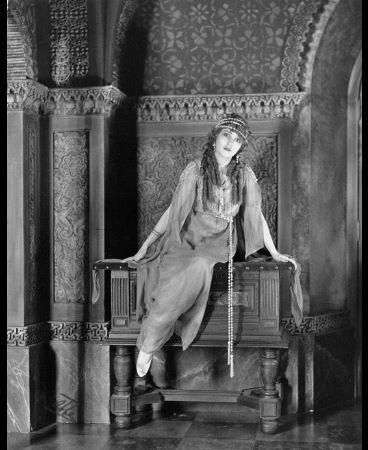
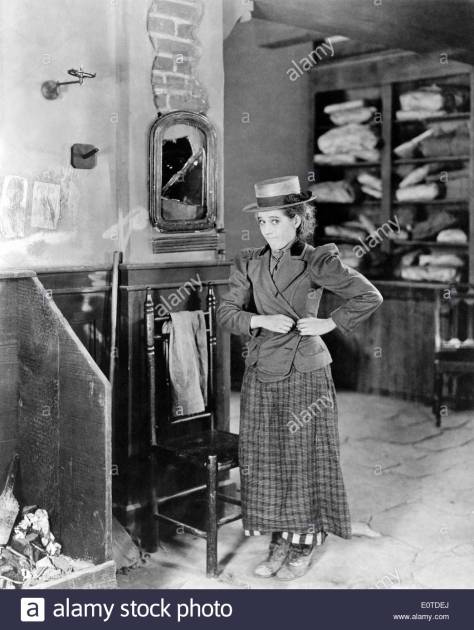
  5. Jump up^ GreenCine | Experimental/Avant-Garde
  6. Jump up^ “Experimental Film – married, show, name, cinema, scene, book, story, documentary”.
  7. Jump up^ “Douglass Crockwell, Alphabet of Illustrators, Chris Mullen Collection”.
  8. Jump up^ “Hollywood Quarterly”.
  9. Jump up^ Cinema, Experimental; America, Cinema Crafters of; Amberg, George (1 January 1969). Platt, David; Jacobs, Lewis; Stern, Seymour; Braver-Mann, B. G., eds. “Experimental Cinema 1930-1934 Periodical”. Arno – via Amazon.
  10. Jump up^ “Interview with Bruce Posner, the curator”.
  11. Jump up^ “Collectif Jeune Cinéma”.
  12. Jump up^ “Light Cone – Distribution, diffusion et sauvegarde du cinéma expérimental”.
  13. Jump up^ Dominique Noguez, « Qu’est-ce que le cinéma expérimental ? », Éloge du cinéma expérimental, Paris, Centre Georges-Pompidou, 1979, p. 15.

Clair 1

References

  • A. L. Rees, A History of Experimental Film and Video (British Film Institute, 1999).
  • Malcolm Le Grice, Abstract Film and Beyond (MIT Press, 1977).
  • Scott MacDonald, A Critical Cinema, Volumes 1, 2, 3, 4 and 5 (Berkeley: University of California Press, 1988, 1992, 1998, 2005, and 2006).
  • Scott MacDonald, Avant-Garde Film: Motion Studies (Cambridge: Cambridge University Press, 1993).
  • James Peterson, Dreams of Chaos, Visions of Order: Understanding the American Avant-Garde Cinema (Detroit: Wayne State University Press, 1994).
  • Jack Sargeant, Naked Lens: Beat Cinema (Creation, 1997).
  • P. Adams Sitney, Visionary Film: The American Avant-Garde (New York: Oxford University Press, 1974).
  • Michael O’Pray, Avant-Garde Film: Forms, Themes and Passions (London: Wallflower Press, 2003).
  • David Curtis (ed.), A Directory of British Film and Video Artists (Arts Council, 1999).
  • David Curtis, Experimental Cinema – A Fifty Year Evolution (London. Studio Vista. 1971)
  • Wheeler Winston Dixon, The Exploding Eye: A Re-Visionary History of 1960s American Experimental Cinema (Albany, NY: State University of New York Press, 1997)
  • Wheeler Winston Dixon and Gwendolyn Audrey Foster (eds.) Experimental Cinema – The Film Reader (London: Routledge, 2002)
  • Stan Brakhage, Film at Wit’s End – Essays on American Independent Filmmakers (Edinburgh: Polygon. 1989)
  • Stan Brakhage, Essential Brakhage – Selected Writings on Filmmaking (New York: McPherson. 2001)
  • Parker Tyler, Underground Film: A Critical History (New York: Grove Press, 1969)
  • Jeffrey SkollerShadows, Specters, Shards: Making History in Avant-Garde Film (Minneapolis: Minnesota UP, 2005)
  • Jackie Hatfield, Experimental Film and Video (John Libbey Publishing, 2006; distributed in North America by Indiana University Press)
  • Gene Youngblood, Expanded Cinema (Dutton, 1970) available as pdf at Ubuweb
  • Dominique Noguez, Éloge du cinéma expérimental (Paris Expérimental, 2010, 384 p. ISBN 978-2-912539-41-0, in French) Paris Expérimental
  • Al Rees, David Curtis, Duncan White, Stephen Ball, Editors,Expanded Cinema: Art, Performance and Film, (Tate Publishing, 2011)

Breve 1

R W Fassbinder film season – BFI April/May 2017


Rainer Werner Fassbinder was one of post-war Germany’s greatest filmmakers.

“I’d like to be for cinema what Shakespeare was for theater, Marx for politics and Freud for psychology: someone after whom nothing is as it used to be.”

Rainer Werner Fassbinder 

Love is Colder Than Death 1

BFI Southbank dedicates a two-part season in April and May to the works of R W Fassbinder.

The season begins a the end of March with an introduction. Dr Martin Brady, will introduce the season with a lecture on Fassbinder’s gangster films and melodramas, and explore the environment of 1960’s and 70’s Germany from which they emerged. On 29th March, there will be a screening of The Marriage of Maria Braun followed by a Q&A with actor Hanna Schygulla and editor/Fassbinder’s second wife Juliane Lorenz, who is also the president of Rainer Werner Fassbinder Foundation.

From there, the season will follow his film and television works retrospectively from Love is Colder than Death, and Katzelmacher, through Fear Eats The Soul, The Merchant of Four Seasons, The Bitter Tears of Petra von Kant, World on a Wire, to Lilli Marlene and Querelle.

Fassbinder’s short films, several documentaries on his life and work,  and education events are also included in the season.

This is a rare opportunity to see most of R W Fassbinder’s works on 35 mm and on new restoration prints.

Fassbinder Foundation Logo 1

For bookings and further information please visit BFI On Line:

https://whatson.bfi.org.uk/Online/default.asp?BOparam::WScontent::loadArticle::permalink=fassbinder&BOparam::WScontent::loadArticle::context_id=

Marriage of Maria Von Braun 1

Lili Marleen 1

Veronica Voss 1

Lola 3

Berlin Alexanderplatz 1

Bitter Tears of Petra Von Kant 1

Effie Briest 1


R W FASSBINDER SEASON – BFI

APRIL 2017

Season opening

The Marriage of Maria Braun (1978)  plus live Q&A with Hannna Schygulla and Juliane Lorenz

28/03/2017

TRAILER


Love Is Colder Than Death (1969)

FILM CLIP


The City Tramp (1966)

Short Film


The Little Chaos (1967)

Short Film


Katzelmacher (1969)

TRAILER


Gods of the Plague (1969)

TRAILER


Why Does Herr R Run Amok (1969)

FILM CLIP


Rio Das Mortes (1970)

FILM CLIP


Whity (1970)

FILM CLIP


The Niklashausen Journey (1970)

FILM CLIP


Beware of a Holy Whore (1970)

TRAILER


The American Soldier (1970)

TRAILER


Pioneers in Ingolstadt (1970)

TRAILER


The Merchant of Four Seasons (1971)

FILM CLIP


The Bitter Tears of Petra Von Kant (1972)

TRAILER


Eight Hours Don’t Make a Day (1972)

TV Series

eight-hours-dont-make-a-day


World on a Wire (1973)

TV Series

TRAILER


Martha (1973)

FILM CLIP


Effi Briest (1974)

FILM CLIP


Fox and His Friends (1974)

TRAILER


I Don’ Just Want You To Love Me – The Flimmaker Rainer Werner Fassbinder (1992)

Dir: Hans Gunther Pflaum

Documentary Film


Fassbinder (2015)

Dir: Annekatrin Hendel

Documentary Film


Fassbinder Education Events

Rainer Werner Fassbinder: Wunderkind, Iconoclast, Star

Introduction Lecture by Martin Brady

28/03/2017

fox-and-his-friends-1975-001-rainer-werner-fassbinder-waistcoat-1000x750


BFI Course: The Many Faces of Rainer Werner Fassbinder

Martin Brady and Erica Carter

13/04 – 08/06/2017

Richard-TheDocumentariesTheyDeserveHannahArendtandRainerWernerFassbinder-1200


Study Day: Fassbinderian Politics

22/04/2017

rainer werner fassbinder hanna schygulla


Cinema Europe: The Other Hollywood


Cinema Europe 3

Prepared by Daniel B Miller

Cinema Europe: The Other Hollywood (1995) is a documentary film series produced by David Gill and silent film historian Kevin Brownlow.[1]

Cinema Europe 5

The six-part mini-series focuses on the origin of European cinema, from its infancy as a novelty created by French inventors Auguste and Louis Lumière to its flourishing as the pinnacle of film-making in the silent era and as a serious commercial contender against America (that is, until the surge of the Nazis).[2] The important series contains much rare footage and offers an even-handed analysis of the specific strengths and weaknesses of the various national film industries during this first flourishing of film as art.

The documentary is narrated by filmmaker and actor Kenneth Branagh. Original music in the film was composed by Carl Davis, Philip Appleby & Nic Raine.[3]

Cinema Europe 6

The series originally aired on the BBC in 1995, and on Turner Classic Movies in the US in 1996. In 2000, Image Entertainment released the whole series on a 2-disc DVD (3 episodes on each disc).

The documentary was shown from time to time on public television stations, usually at late night slots, due to its length and occasional sexual frankness.

Episodes

The documentary is divided into the following episodes (with original BBC airdates):[2]

  • “Where It All Began” (Introductory Episode)
October 1, 1995
Highlighting the world’s first public presentation of films in Paris, the silent film industries in Denmark and Italy, the comedies by Max Linder and Ernst Lubitsch, Abel Gance‘s J’accuse and the onset of World War I.

Cinema Europe 8

Cinema Europe 9

Cinema Europe 11

  • “Art’s Promised Land” (Sweden)
October 8, 1995
Including Ingeborg Holm, Terje Vigen and The Phantom Carriage by Victor Sjöström and Greta Garbo‘s star-making performance opposite Lars Hanson in Mauritz Stiller‘s Gosta Berling’s Saga. Directed by Michael Winterbottom.

Cinema Europe 12

Cinema Europe 13

Cinema Europe 14

  • “The Unchained Camera” (Germany)
October 15, 1995
Featuring The Cabinet of Dr. Caligari, Battleship Potemkin by Sergei Eisenstein, Metropolis, Die Nibelungen by Fritz Lang, Joyless Street starring Greta Garbo, F. W. Murnau‘s Nosferatu, Emil Jannings, The White Hell of Pitz Palu featuring Leni Riefenstahl and Louise Brooks becomes a star in G. W. Pabst‘s Pandora’s Box and Diary of a Lost Girl.

Sergei Eisenstein

Cinema Europe 7

Cinema Europe 16

Fritz Lang, circa 1937

Cinema Europe 18

Cinema Europe 19

Cinema Europe 20


Cinema Europe 22

Cinema Europe 23

  • “The Music of Light” (France)
October 22, 1995
Highlighting Abel Gance‘s masterpieces, Napoleon and La Roue.

Cinema Europe 26

Cinema Europe 25

Cinema Europe 24


Cinema Europe 28

Cinema Europe 29

Cinema Europe 30

Cinema Europe 31


  • “Opportunity Lost” (Britain)
October 29, 1995
Exploring the early career of Alfred Hitchcock.


Cinema Europe 33

Cinema Europe 34

Cinema Europe 35

Cinema Europe 36

Cinema Europe 37

Cinema Europe 38

Cinema Europe 39

Cinema Europe 40

Cinema Europe 41

Cinema Europe 42

Cinema Europe 44


  • “End of an Era” (Finale)
November 5, 1995
Focusing on the arrival of sound films, The Jazz Singer, The Blue Angel, and the onslaught of World War II.

Cinema Europe 45

Cinema Europe 46

Cinema Europe 48

Der blaue Engel

References

  1. Jump up^ Cinema Europe: The Other Hollywood, Part 1 – Where it All Began (1995), review in New York Times
  2. ^ Jump up to:a b Cinema Europe: The Other Hollywood at the Internet Movie Database
  3. Jump up^ Douglas Pratt. Doug Pratt’s DVD: Movies, Television, Music, Art, Adult, and More!, Volume 1, UNET 2 Corporation, 2004. pg. 252
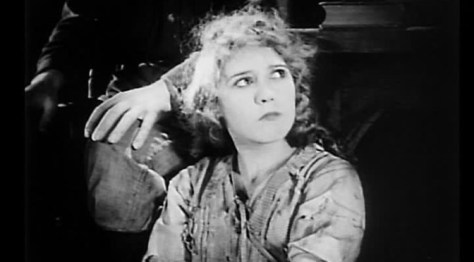
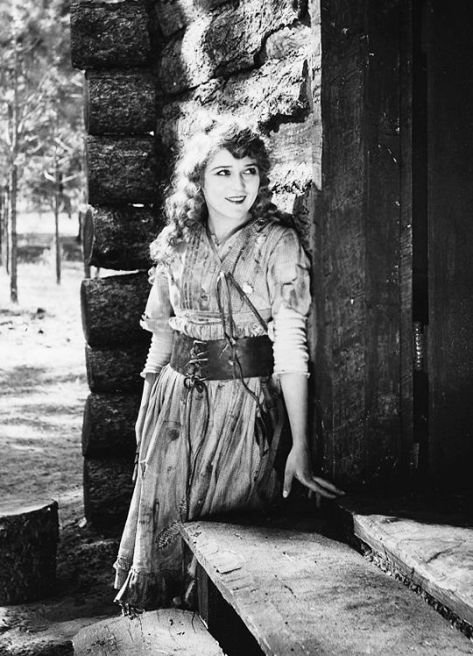
Cinema Europe 50

External links

Cinema Europe 51

Cinema Europe 52

Cinema Europe 53

Film Dialogue is a forum for anyone with interest in cinema and film history