

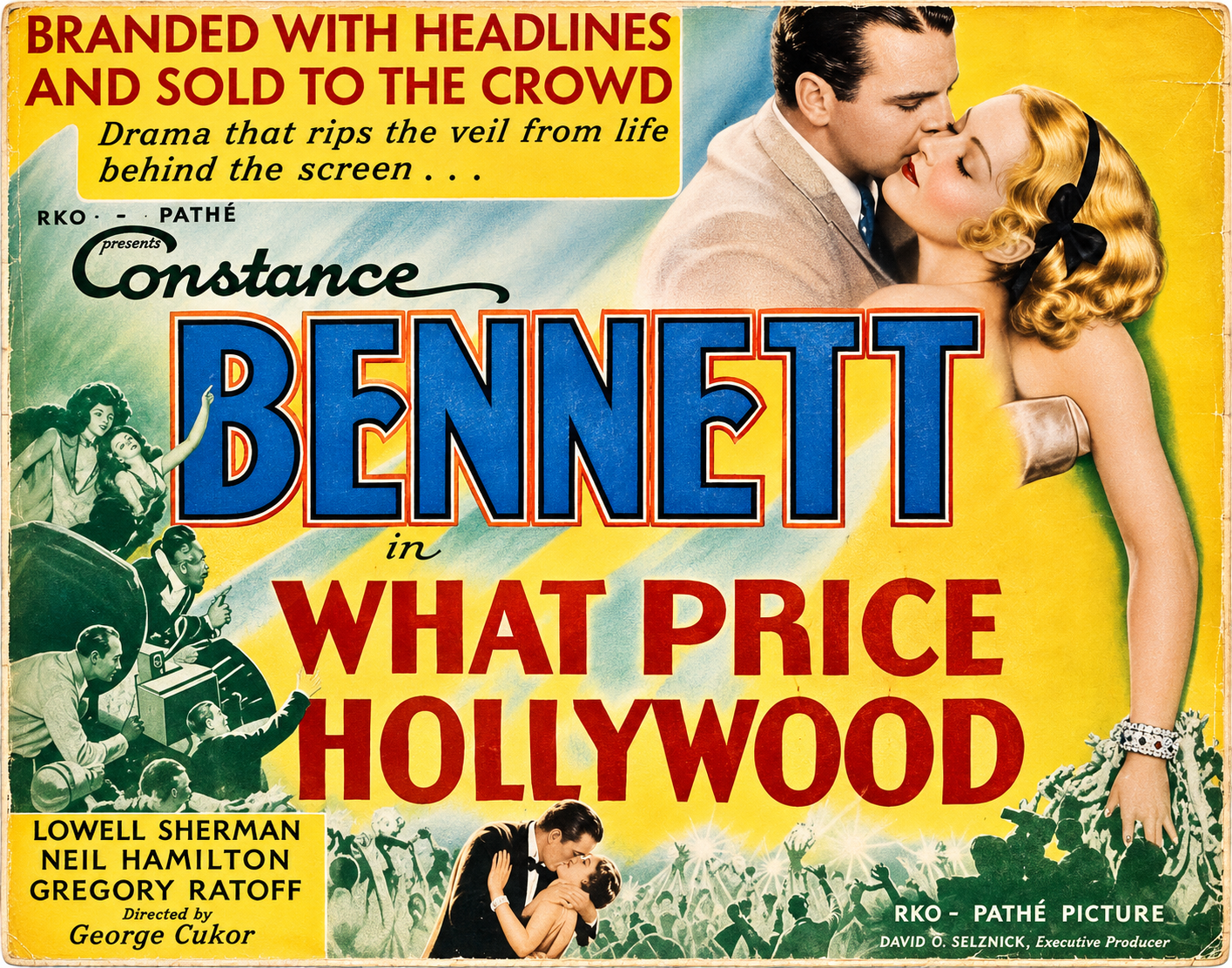

Julian: There is a 1932 film about Hollywood that opens with a waitress kissing a photograph of Clark Gable and ends with the question of whether any of it was worth it — which, depending on your day, is either very relatable or very on the nose.
Eleanor: Film Dialogue has published a deep, two-part essay on What Price Hollywood?, Georgje Cukor’s 1932 pre-Code drama — covering its production history, its biographical sources, and what the film actually does with ambition, loyalty, and the cost of celebrity.
Julian: Let’s start with the film itself and the world it was built from.
What Price Hollywood? — The Dream and Its Damage
Eleanor: The essay frames the film’s central tension this way: Mary Evans, an ambitious waitress, rises into stardom while the celebrated director who opened that door, Max Carey, loses his professional standing to alcoholism — and the film holds both trajectories at once without making her gain his loss.
Julian: The essay calls it, and I want to read this directly, “a work bordering on a masterpiece in the confidence with which its comedy, romance, melodrama and tragedy belong to one another.”
Eleanor: That confidence starts in the opening scene. Mary studies fan magazines, imitates Greta Garbo, kisses a photograph of Clark Gable — gestures the essay describes as playful and slightly absurd, but also as a woman rehearsing an imagined future. The magazine offers an alternative to her present circumstances.
Julian: And then the film does something quietly unusual — it makes her work for it.
Eleanor: Right. There is a sequence where Mary attempts to descend a staircase, deliver a line, and register the discovery of a body — a seemingly simple assignment she cannot manage. The essay notes that Bennett’s ability to make an inexperienced performer look unconvincing is itself a demonstration of skill: we are watching an accomplished actress organize an unsuccessful performance within a successful one.
Julian: She goes home and practices. Cukor shows the repetition, the adjustment, the gradual discovery of the right manner. The fantasy of advancement is supported by what the essay calls “an unexpectedly concrete account of labour.”
Eleanor: The essay is specific about what Max contributes and what he cannot. He can open a door; he cannot do Mary’s work for her. Lowell Sherman plays him with charm and spontaneity — the essay says he gives Max “a cultivated air of being only partially governed by the rules that constrain other people.”
Julian: Which is, of course, a description that stops being charming at a certain point.
Eleanor: Exactly. The essay tracks how the industry’s requirements make Max’s difficulties professionally damaging — long hours, production schedules, commercial expectations — while being careful not to reduce his addiction to an inevitable consequence of work. His drinking has its own destructive momentum.
Julian: On the biographical sources, the essay is methodical. It identifies Marshall “Mickey” Neilan, Lowell Sherman himself, John Barrymore, and Tom Forman as reported influences on Max — each contributing something different: Neilan the pattern of talent becoming impossible to employ, Sherman and Barrymore the charm and self-destructiveness, and Forman, who took his own life in 1926, the reality behind a fictional death.
Julian: The essay is careful to call these reported influences rather than solved identifications. The production record doesn’t establish any one definitive model.
Eleanor: The same care applies to the film’s origins. The essay traces Selznick’s early advocacy for a “sensational comeback” for Clara Bow, and J. E. Smyth’s research connecting Bow’s public history — poverty, sudden celebrity, powerful men, destructive publicity — to the screenplay’s development. But Mary Evans is not a screen biography of Bow.
Jukian: The screenplay passed through enough hands that separating the original conception from its later transformations became genuinely difficult — which the essay treats as a feature of the professional world that made the film, not a problem to be solved.
Eleanor: Gregory Ratoff as producer Julius Saxe is given real attention. The essay calls him “absolutely delightful” and reads the character as embodying the studio system’s mixture of financial calculation and intense personal investment. His refusal to keep employing Max “solves a problem for the studio while intensifying a crisis for the man.”
Julian: And the essay argues that if Saxe were simply a villain, the film’s account of Hollywood would become easier and less convincing.
Eleanor: Mary’s marriage to Lonny Borden, played by Neil Hamilton, opens another line of argument. The essay reads the conflict between them as exposing “competing ideas about independence, domestic stability and the distribution of sacrifice” — her celebrity becomes a condition of any relationship, which he experiences as interference.
Julian: The wedding, which Saxe turns into a publicity spectacle, is where the essay makes a point that lingers: the reader who once imagined entering a celebrity’s life has become someone whose own life will be offered to other readers.
Eleanor: And then Max dies in Mary’s home, and the same publicity machinery that built her image makes her grief into insinuation. The essay draws a direct line from the opening magazine fantasy through the public wedding to the scandal — the same appetite, changing only its emotional register.
Julian: On the financial record, the essay is precise: RKO ledger figures show $571,000 in total earnings and an approximately $50,000 loss. Later accounts describing a near-break-even result require that care.
Eleanor: The connection to A Star Is Born gets its own section. Selznick’s 1937 production repeated the pattern closely enough that RKO’s legal department prepared a point-by-point comparison and recommended considering a plagiarism action. The essay notes that the disposition of that recommendation has not been established.
Julian: The essay also touches on Born to Love, a 1931 Constance Bennett picture in which romantic separation and motherhood are similarly central — it comes up when the essay considers whether the ending of What Price Hollywood? can really close what the film has opened.
Eleanor: The essay’s conclusion on the ending is honest: Lonny returns, Saxe offers another film, the prospect of reconciliation is there. But the essay finds it difficult to accept that optimism without qualification. The earlier conflicts have a history, and Mary carries grief that Lonny cannot undo.
Julian: What stays with the essay most is Mary’s refusal to let success rewrite the meaning of Max’s kindness — which is, in a film so concerned with professional memory and forgetting, the thing that feels least replaceable.
Eleanor: Bennett’s performance holds all of it together. The essay argues she deserves greater recognition alongside names like Stanwyck and Lombard, and calls her command of comedy, glamour, and emotional vulnerability not an incidental attraction but the human centre the film requires.
Julian: There is something fitting about an essay on professional memory making that case for an actress the culture has partially forgotten.
Eleanor: The pre-Code scandals — Arbuckle, Taylor, Reid — are given historical context too, not as direct sources for the film but as the atmosphere in which audiences already knew how to read a Hollywood life as a story with a moral. The essay is clear that those cases were different in every important respect; their grouping reveals an appetite for an encompassing story of Hollywood corruption, not a reliable account of individual guilt.
Julian: The essay closes on Cukor’s ability to hold all of it — comedy, romance, melodrama, tragedy — without any of it arriving from a wholly different film. The darkness develops from possibilities already present within the pleasures.
Eleanor: What Price Hollywood? is, the essay concludes, an archive gem it recommends without hesitation — for Bennett’s presence, for Cukor’s direction, and for a film that can expose Hollywood’s workings while continuing to transform those workings into entertainment.
Julian: The question the title converts into — not a promise of revelation but a question about human cost — turns out to be the whole film.
Eleanor: And the essay’s answer is that the cost and the pleasure are inseparable. Which is probably why the story kept getting remade.
Julian: Something to sit with until next time.


Leave a Reply